
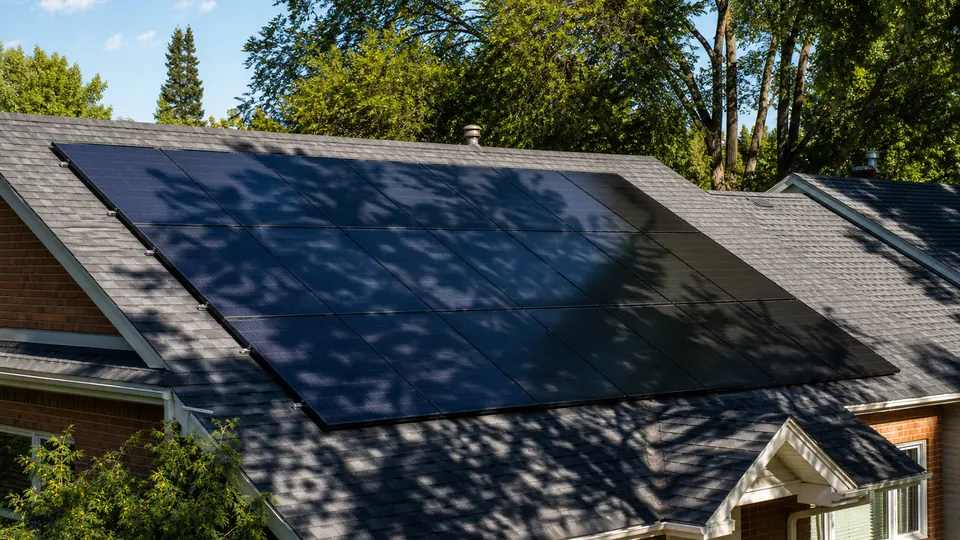
Every Canadian homeowner researching solar starts with an online estimate. Satellite imagery plus regional irradiance data produces instant kilowatt-hour projections — often within ten percent of reality on open suburban lots. Add a century-old oak on the south lawn or a pending six-storey neighbour, and the same tools silently lie.
Professional shading analysis quantifies obstructions across seasons and hours. Knowing when to trust free tools versus paying for site-specific measurement protects you from undersized savings and oversize regret.
What online estimators actually model
Popular platforms — PVWatts, Aurora remote design, Google Project Sunroof where available — use:
- Digital surface models for roof pitch and azimuth
- Typical meteorological year (TMY) weather files by nearest city
- Tree height approximations from lidar where datasets exist
- Standard derates for soiling, inverter efficiency, and wiring
They struggle with young trees (future shade), fine obstructions (chimneys, vent stacks), and reflecting surfaces. Rural Ontario and BC may lack recent lidar — defaults assume clearer horizons than reality.
Methods professionals use on site
Solar pathfinder and SunEye devices: Fisheye lens or digital horizon capture at proposed array location. Software overlays sun paths for every month, calculating shade loss percentages.
Drone photogrammetry: Useful for complex multi-plane roofs and commercial arrays.
LiDAR-assisted remote design: High-end installers combine aerial data with ground photos — nearly as accurate as site visit when data is fresh.
Seasonal shade differs from annual average
A chimney shading modules only in November–January may drop winter production twenty percent while annual average shows eight percent — painful if you sized net metering around winter heat pump load. Good reports break losses by month, not only annual kWh.
Urban infill and future shade risk
Toronto, Vancouver, and Montreal zoning allows mid-rise infill on neighbouring lots. Municipal development applications are public — check for proposed structures south of your roof. Online tools never include unbuilt towers. Professional consultants sometimes add scenario analysis for known planning applications.
When remote estimates are enough
- Suburban tract home on open lot with no trees taller than the roof ridge
- Ground-mount in open field with surveyed setback from tree lines
- Flat commercial roof above surrounding parapet with no nearby high-rises
- Second quote confirming first within five percent production
When to insist on site-specific shade study
- Mature deciduous or evergreen trees within 1.5× tree height of array plane
- Heritage neighbourhoods with protected canopy
- Multi-plane roof with dormers and valleys
- Microinverter layout needing string-level shade mapping
- Production guarantee in contract tied to modelling assumptions
Reading a shade report
| Metric | What it means |
|---|---|
| Solar access (%) | Fraction of available sunlight reaching array plane annually |
| Tof (transmission) | Shade factor per module or segment |
| Monthly breakdown | Identifies winter-specific losses |
| Horizon elevation diagram | Shows which obstacles block which sun angles |
Solar access above 90 percent is excellent; 80–90 acceptable with adjusted expectations; below 80 warrants design changes — different roof plane, ground mount, or tree trimming negotiations.
Tree trimming and neighbour relations
Shade from your own trees: arborist trimming may restore production without removal. Shade from neighbour trees: legal remedies vary by province — Ontario's tree law and BC neighbour disputes differ. Solar economics rarely justify litigation; diplomatic trimming agreements or array relocation win more often.
Microinverters versus optimizers under partial shade
String inverters suffer disproportionately from partial shade — one shaded module drags entire string. Module-level power electronics (MLPE) mitigate but do not eliminate shade — they reduce mismatch losses. Do not skip shade analysis because you chose microinverters; production guarantees still depend on realistic modelling.
Cost of professional analysis
Site shade studies run $150–$500 as standalone service; often included in full design proposals from reputable installers. Paying twice if the first quote skipped site visit is cheaper than living with a 25 percent production shortfall for twenty-five years.
Red flags in installer proposals
- Production model without stated shade source data
- Guarantee percentage with no remediation clause for shade misestimate
- Refusal to visit property citing satellite-only design
- Annual production exceeding PVWatts upper bound for your postal code
Bottom line
Online estimates are screening tools, not contract gospel. Canadian homes under tree canopies and in dense cities need horizon measurement grounded in local seasons. Demand monthly shade breakdown before you sign — the maple that barely whispers in June can dominate your December bill.