
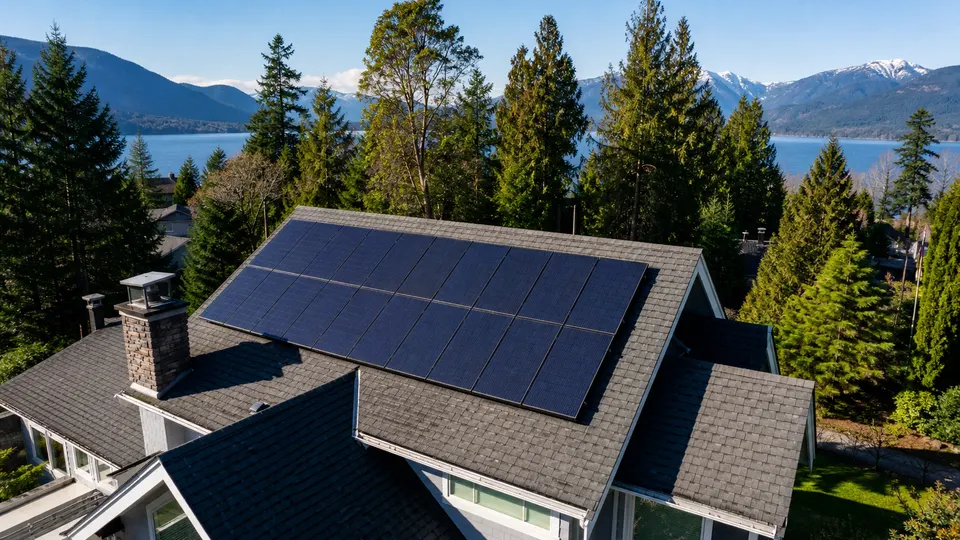
Solar modelling software defaults to south-facing thirty-degree pitches because that maximizes annual energy at mid-latitudes. Canadian homeowners in Thunder Bay, Prince George or suburban Edmonton rarely present such ideal geometry. Roofs face southeast toward the street, pitches sit at twelve degrees on modern tract housing, and mature spruce cast winter shadows when the sun rides low. At northern latitudes the sun's path across the sky changes dramatically through the year — orientation and tilt decisions that look suboptimal on paper sometimes match how households actually consume power.
This guide translates azimuth and tilt into practical design choices for high-latitude Canadian roofs without pretending every home can host a textbook south array.
Azimuth basics for Canadian roofs
Azimuth measures compass direction: true south is 180° in northern hemisphere site plans. Deviations east or west reduce annual production but not always proportionally to intuition. A roof facing 210° (south-southwest) in Winnipeg may lose only a few percent versus perfect south; a roof facing 240° (west) can still deliver strong afternoon peaks valuable for summer air conditioning and post-work EV charging.
Natural Resources Canada publishes solar resource maps by municipality. Use local TMY weather files in production estimates — not national averages — because cloud regimes differ sharply between coastal BC, continental Prairies and Laurentian shield communities.
Optimal tilt versus roof reality
Rule-of-thumb optimal fixed tilt equals latitude for year-round maximization. At 53°N in Edmonton that suggests a steep pitch near fifty-three degrees — rare on residential housing. Most homes sit between four and thirty degrees. Installers flush-mount to existing pitch unless a tilt kit on a flat or low-slope section adds five to fifteen degrees within structural limits.
Steeper tilts help snow shed in northern winters but increase wind load on racking. Shallow pitches retain snow longer, suppressing winter production but sometimes acceptable if annual kWh targets still meet financial goals.
Production impact by orientation
Illustrative annual production index for a fixed array at 50°N latitude, 15° roof tilt, normalized to south = 100%:
| Roof azimuth | Approx. annual yield index | Seasonal character |
|---|---|---|
| South (180°) | 100% | Balanced summer/winter |
| Southeast (135°) | ~95% | Morning bias, good shoulder seasons |
| Southwest (225°) | ~95% | Afternoon bias, summer peak shift |
| East (90°) | ~80% | Strong spring/fall mornings |
| West (270°) | ~80% | Strong summer afternoons |
| North (0°) | ~55–65% | Weak winter, often not recommended |
These indices vary with local albedo, cloud cover and shading. They support comparison shopping between roof planes on the same house — not absolute generation guarantees.
East-west split arrays on northern homes
Developers from Calgary to Ottawa increasingly build gable roofs with east and west planes and no large south face. Splitting modules across both wings — sometimes called east-west or dual-tilt layouts — flattens the daily production curve. Peak output drops versus a consolidated south array, but morning and afternoon shoulders rise.
Benefits at high latitude:
- Extended production window matches longer summer daylight hours
- Reduced inverter clipping if midday peak is broadened
- Better alignment with households that consume steadily through waking hours
- Symmetric aesthetics on street-facing gables
Microinverters or optimizers help when each wing experiences different shading from neighbouring buildings as sun azimuth shifts.
Ground mounts and latitude-adjusted tilt
Rural properties in northern Alberta, Saskatchewan and northern Ontario often have space for ground mounts with tilt adjusted to latitude or steeper for snow shedding. Ground systems allow seasonal tilt adjustment — rarely cost-effective for homeowners but occasionally used on off-grid cottages where winter load is critical.
Ground mounts must respect setbacks from property lines, wells and septic fields per municipal zoning. Snow drifting between rows matters: spacing that works in July may shade modules in February when drifts pile south of taller rows.
Shading at low solar elevation
At 55°N the December sun elevation at solar noon may sit near fifteen degrees above the horizon. Objects that clear summer shading paths — vent pipes, neighbour fences, tree trunks — may block winter production entirely. Horizon shading analysis should use December twenty-first, not June, when evaluating northern sites.
Tree trimming negotiations with municipalities on boulevard plantings arise in older Edmonton and Saskatoon neighbourhoods. Document shade studies before permit applications if heritage trees are involved.
Time-of-use and self-consumption alignment
Where utilities move toward time-of-use billing — more common in Ontario and emerging elsewhere — west-facing arrays that peak during afternoon rate periods can outperform south arrays on bill savings despite lower total kWh. Northern latitudes with long summer evenings amplify that effect for households running heat pumps on delayed schedules.
Net metering regimes that credit exported kWh equally regardless of time reduce the value of orientation tuning unless load shifting devices enter the home.
Flat roof and low-slope commercial parallels
Homeowners with low-slope additions or garage roofs sometimes mimic commercial tilt kits on rubber membranes. Ballast or attached tilt frames target ten to twenty degrees. Wind load limits maximum tilt on open prairie sites; structural review is mandatory. For residential scale, attached tilt on garage roofs visible from the street may trigger municipal design review in conservation districts.
Monitoring expectations through the seasons
Northern arrays produce a disproportionate share of annual energy from April through September. Homeowners should expect December and January to contribute single-digit percentages of the annual total even on unshaded south roofs. Monitoring portals that compare monthly production to modelled baselines catch shading defects or inverter faults faster than comparing to July peaks alone.
Design workflow for imperfect roofs
- Identify all usable roof planes with azimuth, pitch and obstructions
- Run shade analysis for winter and summer solstice plus equinox
- Model each plane separately, then combined, using local weather files
- Compare financial metrics — payback, bill offset — not only nameplate kW
- Choose MLPE if wings or strings face mismatched shading or orientation
- Confirm structural capacity for tilt kits if flush mount underperforms
When to accept non-south placement
East or west roofs with clear solar access often beat south roofs shaded by chimneys or mature canopy. A smaller unshaded southwest garage roof may outproduce a larger shaded south main roof. At northern latitudes the marginal cost of chasing perfect azimuth must be weighed against reroofing, tree work or ground-mount civil costs.
At fifty degrees north, the best roof for solar is the one that sees low winter sun — not necessarily the one that faces the street.
Roof orientation and tilt in northern Canada are constraint-optimization problems tied to local weather, load patterns and geometry you cannot rotate. Use latitude-aware modelling, respect winter sun angles in shade studies, and treat east-west splits as legitimate design strategies — not failures — when south pitch simply does not exist on the home you own.