
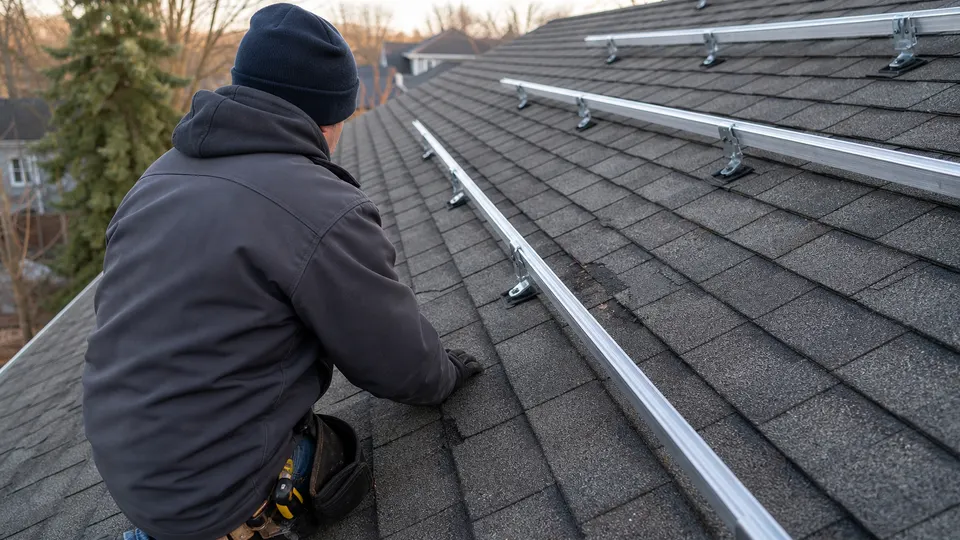
Solar modules last twenty-five to thirty years; asphalt shingles often last fifteen to twenty-five depending on grade, ventilation and climate. That mismatch is the most predictable hidden cost in residential solar. Owners who skip roof age assessment in year one pay twice for labour when shingles fail at year twelve and arrays must come off temporarily — sometimes in winter when Canadian roofers are booked months ahead.
Deciding whether to re-roof before solar, bundle both projects, or defer solar until after replacement requires honest roof inspection, not salesperson optimism about remaining shingle life.
How to assess remaining roof life
Start with installation records: shingle brand, layer count, underlayment type and year of last full replacement. Without records, hire a roofer or qualified inspector familiar with your region's weathering patterns. Warning signs on asphalt:
- Curling or brittle tab edges, granule loss exposing mat
- Soft spots when walking supported paths on the deck
- Multiple prior overlays trapping heat and shortening life
- Flashing rust or step flashing gaps at wall intersections
- Interior ceiling stains indicating active leaks
Metal standing seam and concrete tile roofs often outlast first-generation solar installs — timing solar with mid-life maintenance rather than full tear-off may suffice.
The remove-and-reinstall cost surprise
When shingles fail under an existing array, contractors must safely de-energize, disconnect, remove modules and racking, replace roofing, then reinstall and recommission. In 2026 Canadian markets, owners report $3,000–$8,000+ for residential remove-and-reinstall depending on system size, store access, steep pitch and whether original flashing was reusable.
Some warranties cover workmanship on original penetrations but not re-install labour after a third-party roofer touched layout. Clarify responsibility before any storm damage repair involving separate trades.
Option A: Re-roof first, then solar
Clean sequencing when roof urgency is high. Advantages:
- Installers flash into fresh underlayment and warranty-compliant shingle courses
- Structural repairs to sheathing happen without modules overhead
- Homeowner negotiates roofing and solar contracts separately with clear scopes
Risk: delay solar incentives or rate programs if roofing pushes timelines. Coordinate permit inspections so electrical work follows closed roofing permit without gaps exposing underlayment to weather.
Option B: Combined re-roof and solar project
Single project manager or partnering roofer-installer teams handle sequencing: tear-off, deck repair, ice-and-water shield at eaves and penetrations, shingle courses, mounting foot installation, racking, modules. Common on Ontario and BC projects where integrated bids reduce finger-pointing if a leak appears at a standoff.
Demand written allocation of leak liability for ten years. Ask whether roofing manufacturer certification requires specific mount products — some shingle brands publish approved flashing kits for solar.
Option C: Solar now on roof with verified remaining life
If inspection confirms eight to fifteen years of serviceable life aligned with your home tenure plans, proceeding may be rational — especially if you plan to sell within that window and document roof age for buyers. Reserve a line item in household budget for future remove-and-reinstall equal to roughly half current install labour.
Not rational when roof shows active leaks or is one layer away from mandatory full tear-off under municipal code overlay limits.
Flashing details that survive Canadian freeze-thaw
Proper solar flashing uses elevated mounts with sealed bolt penetrations, not lag screws through shingles alone. Ice-and-water membrane should extend upslope of each foot in cold climates. Step flashing integration at dormers and chimneys must be rebuilt if solar layout intersects those zones — a common add-on discovered mid-install on older Halifax and Montreal homes.
Low-profile flashed mounts reduce exposure to wind-driven rain and ice dam backup. Cheap leak brackets fail silently until interior damage appears.
Metal, tile and flat roofs
Standing seam metal: Clamp attachments avoid penetrations; verify metal gauge and seam compatibility. Metal may last forty years — solar likely refreshes before roof.
Concrete tile: Fragile underfoot; use hook mounts designed for tile profiles; budget tile replacement pieces.
Flat membrane: Often favours ballast or fully adhered racks on new membrane installs; re-roof timing should bundle both.
Insurance and warranty overlap
Roofing material warranties may void if unauthorized penetrations occur — another argument for certified mount kits and roofer sign-off. Home insurer may require notification of solar install; after re-roof, update policy with photos and contractor certificates.
Financing and rebate timing
Federal and provincial programs occasionally treat roofing and solar as separate eligible expenses. Bundling may affect tax credit categorization or loan program documentation — verify with your accountant for ITC-style business investments on rental properties and with program administrators for residential rebates before assuming one invoice qualifies for both.
Home sale implications
Buyers and inspectors in Toronto, Vancouver and Calgary markets ask: How old is the roof relative to the solar lease or owned array? A new roof plus new solar simplifies transfer; old roof plus young solar triggers price negotiation for deferred re-roof and removal costs. Provide inspection reports at listing.
Decision checklist
- Independent roof inspection with remaining life estimate in writing
- Quote remove-and-reinstall labour even if you hope to avoid it
- Compare bundled versus sequential project total cost and warranty terms
- Confirm ice-and-water and flashing details for your climate zone
- Align project with how long you expect to own the home
- Schedule roofing season — Canadian spring and fall book quickly
When to wait on solar entirely
Active leaks, structural deck rot, or asbestos-containing old roofing materials requiring abatement should be resolved first. Heritage homes needing sympathetic re-roof approval may delay both projects — plan holistically with heritage staff if slate or cedar replacement is concurrent.
Solar on an old roof is a loan against future roofing labour — the interest rate is whatever your local crews charge per watt to come back.
Roof age is the gating question serious installers ask before scheduling crew. Replace or renew the roof when remaining service life falls below your planned ownership horizon, integrate flashing for freeze-thaw, and price the remove-and-reinstall scenario even if you never trigger it. Sequencing beats regret on Canadian roofs where shingles fail mid-winter and modules cannot fly themselves to the ground.