
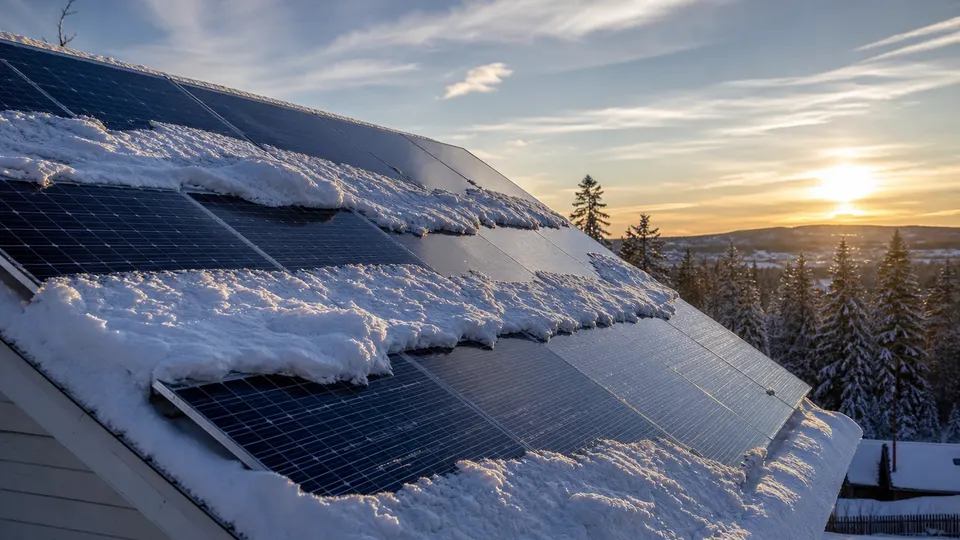
Skeptics point at snow-covered roofs in January and assume solar in Canada hibernates. Reality is more nuanced: cold clear days produce strong wattage when glass is exposed, snow reflection can boost albedo gain on tilted arrays, and annual production models already discount short December days. What winter does impose is mechanical load, intermittent coverage and homeowner impulses to clear panels in ways that crack glass or void warranties.
This article covers snow and ice behaviour on rooftop PV across Canadian climate zones — production impact, structural considerations, insurance angles and maintenance discipline — without repeating the myth that northern arrays only work half the year.
Why cold sunny days outperform expectations
Photovoltaic cells convert light, not ambient heat. Cold air improves semiconductor efficiency relative to the 25 °C laboratory rating conditions printed on module labels. A −10 °C February noon in Saskatoon with fresh snow on the ground can yield surprising inverter output for the hours modules remain clear — sometimes approaching summer peaks adjusted for sun angle.
Natural Resources Canada and provincial utilities incorporate TMY weather files into production estimates that already account for regional snow and cloud patterns. If your installer's proposal assumes zero winter production, ask which dataset they used.
Snow cover duration by roof pitch and region
Tilt angle drives shedding. Steep forty-degree pitches common on Quebec cottages and Nova Scotia capes shed faster than four-degree low-slope additions in suburban Ontario. Chinook-driven melt in Calgary clears roofs within days of storms; persistent lake-effect snow around Thunder Bay may linger weeks on shaded planes.
- Steep south roofs (30°+): Often self-clear within one to three days after storms when sun returns.
- Moderate pitches (15–25°): Mixed; partial cover common through midwinter thaws.
- Low slope (<15°): Highest snow retention risk; may need design acceptance of winter loss.
- East/west wings: Asymmetric melt patterns can mimic shading on string systems.
Albedo and the ground snow effect
Fresh snow reflects diffuse light onto tilted modules from below, partially offsetting coverage losses at array edges during melt transitions. Albedo gains appear in serious production models for open prairie sites; urban yards with tree cover see less benefit. Do not count albedo as a reason to skip structural snow load review — reflected light helps production, not roof capacity.
Structural snow load versus PV dead load
Building codes require roofs to carry snow loads varying by region — higher in northern and mountain zones. Solar racking adds dead load before snow accumulates. Engineers assess combined loading during permit review. Older farmhouses converted to residences in rural Manitoba or New Brunswick may need reinforcement if arrays push cumulative load near design limits.
Panels themselves do not magically shed snow because they are slick — surface friction and frame edges trap slabs. Racking orientation parallel to slope aids slide-off; flat commercial ballast tables may need manual aisle clearing for fire access, not production alone.
Ice dams and roof integration
Ice dams form when heat escapes through roofs, melting snow that refreezes at eaves. Solar mounts do not cause dams, but penetrations and added insulation gaps from install quality can worsen pathways if flashing fails. Proper ice-and-water shield extension upslope of penetrations is standard detail in cold-climate installs — verify it appears in scope of work.
Microinverters and optimizers behind modules add slight warmth compared with bare glass but not enough to melt entire arrays electrically — resist sales claims of self-clearing panels via generation heat alone.
Production loss quantification
Annual winter loss from snow cover varies widely: five to fifteen percent in southern Ontario on steep roofs; fifteen to thirty percent on shallow pitches in northern cities if owners do not intervene. Monitoring data from Canadian co-ops helps calibrate expectations better than national averages.
December and January contribute small fractions of yearly kWh even without snow because sun elevation and day length limit resource. February and March often rebound sharply after clear cold spells — budget mentally for spring production surges on bi-monthly utility bills.
What not to do on a snowy roof
- Do not scrape with metal shovels, rakes with sharp teeth or hockey sticks — micro-cracks void warranties.
- Do not throw road salt or calcium chloride on modules — corrosion damages frames and electrical bonds.
- Do not walk on snow-covered arrays unless installers trained in fall protection say otherwise — hidden ice under snow is slippery; point loads crack cells.
- Do not disable ground-fault protection to force production through partially covered strings — fire risk rises.
Soft roof brushes designed for solar exist; many owners let nature melt panels unless prolonged cover coincides with unusually sunny forecast windows and safe roof access.
Safe maintenance practices
Ground-based inspection with binoculars or drones documents snow retention patterns without climbing. Clear ground paths below eaves for falling ice slabs — arrays can release sudden slides. Trim overhanging branches before winter to reduce shading and icicle formation at array edges.
Commercial O&M crews use harnesses and anchor points; residential owners should hire professionals rather than improvise ladder work on icy gutters.
Insurance and storm documentation
Homeowner policies in hail-prone Alberta and ice-storm-prone Quebec should explicitly list solar. After major events, photograph modules before melt erases evidence. Hail impact may not show immediately; ice wind throw from neighbours' roofs can crack glass at edges.
Design choices that reduce winter pain
- Favour steeper feasible tilts on new builds or garage roofs carrying part of the array.
- Use MLPE if partial snow cover persists asymmetrically across strings.
- Avoid placing bottom row modules in valleys where snow accumulates from upper roof slides.
- Leave maintenance walkways on commercial flat roofs per fire code — residential steep roofs rarely include walks.
- Size expectations with monthly not only annual production charts.
Grid reliability and winter outages
Ice storms in Ontario and New Brunswick knock out distribution lines independent of solar production. Grid-tied arrays shut down during outages unless paired with batteries and proper islanding controls — snow on panels matters less if the neighbourhood is dark. Winter resilience planning belongs in a separate conversation from snow shedding.
Regional snapshots
Prairies: Cold, sunny, windy — quick shed after chinooks; watch wind load on steep mounts.
Southern Ontario: Freeze-thaw cycles and lake effect — partial cover common on shallow suburban roofs.
Coastal BC: Less snow overall but moss and heavy wet snow loads at elevation.
Atlantic: Nor'easters bury shallow pitches; steep coastal homes perform better.
North: Extreme cold helps efficiency when clear; short days cap totals regardless.
Canadian winter solar is a scheduling problem as much as a technology problem — the panels work when the sky is clear; snow decides how many hours that is.
Snow and ice do not disqualify rooftop solar in Canada — they define how arrays are tilted, monitored and maintained. Accept realistic winter production curves, engineer for combined snow and dead load, and keep tools off the glass. The annual energy you lose to snow is usually priced into credible proposals; the damage from improper clearing is not.