
Canadian installers often sell solar as "maintenance-free." That is mostly true compared to furnaces or pools, but neglect still costs kilowatt-hours. Pollen in June, leaves in October, rodent chews in February, and undetected inverter errors in any month compound silently until your monitoring app or utility bill reveals the gap.
This maintenance calendar separates safe homeowner tasks from work requiring licensed electricians — keeping warranties intact across provinces.
Monthly: five-minute monitoring review
Log into your inverter or aggregator portal. Compare current month production to the same month last year and to installer estimates. Investigate sustained drops greater than fifteen percent not explained by weather.
- Check for error codes or offline strings
- Note communication gaps — Wi-Fi drops are common, not always hardware failure
- Record screenshots quarterly for warranty claims
Spring (March–April): post-winter inspection
After final major snow melt, perform ground or drone visual review:
- Scan for cracked glass, frame corrosion, or discoloured hot spots
- Clear debris from array edges — pine needles hold moisture
- Inspect wire runs for chew marks; rural properties see squirrel damage frequently
- Verify critter guard still seated along roof edges
- Confirm inverter ventilation paths unobstructed after ice season
Do not walk on icy or wet roofs. Binoculars or pole-mounted cameras suffice for most suburban arrays.
Summer (June–August): cleaning and vegetation
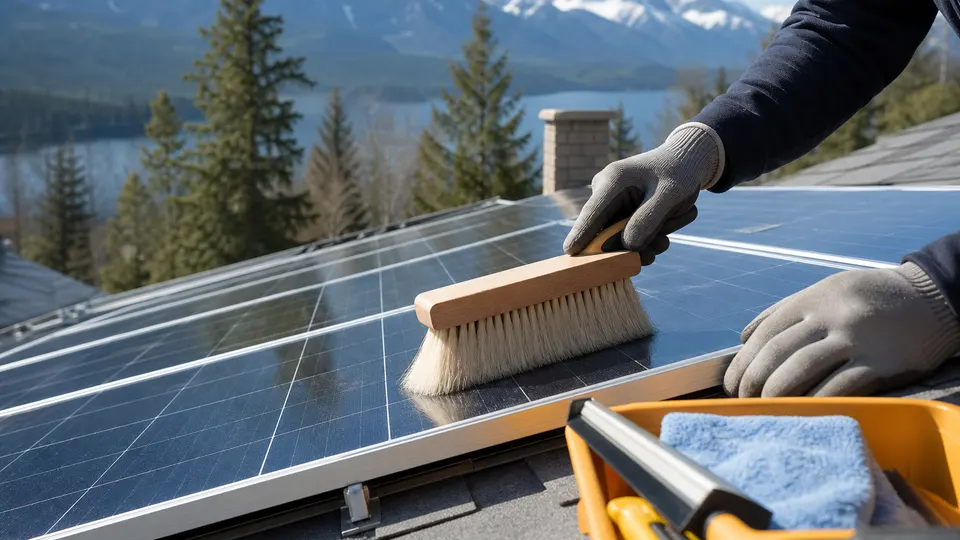
Rain cleans panels adequately in most Canadian cities. Manual cleaning helps where:
- Pollen coats modules during agricultural bloom periods
- Bird droppings concentrate under roosting sites
- Construction dust from nearby renovation persists
Use deionized water or soft hose spray from ground level with squeegee-on-pole kits. Avoid pressure washers and abrasive pads. Clean early morning when modules are cool — thermal shock from cold water on hot glass risks micro-fractures.
Trim branches encroaching on solar access. Shading from growth you tolerated in year one becomes significant by year five.
Fall (September–October): pre-winter hardening
- Clear leaves from gutters and array skirts
- Tighten any visible clamp hardware only if you are trained — otherwise note for installer
- Test ground-fault and arc-fault indicators per manufacturer guidance
- Document roof condition before snow season for insurance baseline
Winter: snow strategy without warranty voids
Let gravity and wind shed snow on steeper roofs. Soft roof rakes with foam edges can help from ground level on single-storey homes — never metal on glass. Ground-mount owners may clear paths between rows for albedo access but panel clearing is optional economics: one hour of labour for perhaps 5–15 kWh recovered.
DIY versus professional tasks
| Task | Homeowner OK? | Notes |
|---|---|---|
| Monitoring review | Yes | Document anomalies |
| Ground-level visual inspection | Yes | No roof walk without fall protection |
| Soft cleaning from ground | Yes | Follow manufacturer warranty terms |
| Roof walking | Discouraged | Fall hazard; roof warranty issues |
| Inverter internal work | No | Licensed electrician only |
| DC connector troubleshooting | No | Live DC strings present shock risk |
| Wire repair after rodent damage | No | Permit and inspection required |
Annual professional visit: worth it?
Some installers offer O&M contracts at $150–$400/year covering electrical checks, torque verification on racking, and thermal imaging. Value peaks on:
- Large arrays above 10 kW
- Steep or complex roof geometries
- Systems out of standard warranty where early fault detection saves replacement cost
Many residential owners alternate DIY visual years with professional visits every three to five years unless monitoring flags issues.
Insurance and hail documentation
After Alberta or Ontario hail events, photograph modules and timestamps before cleanup crews arrive. Insurers may conflate roof and solar damage. Keep serial numbers from install paperwork accessible.
Maintenance log template
Keep a simple spreadsheet: date, task, production that month, notes, photos folder link. Future buyers and warranty claims benefit from documented care — especially on Ontario and BC homes where solar adds resale narrative.
Bottom line
Treat annual solar maintenance like changing HVAC filters: modest effort, disproportionate return. Canadians who glance at monitoring in March, clean pollen in July, and clear leaves in October rarely face surprise production cliffs. Call professionals for anything involving live DC, roof penetration, or inverter internals — the savings from DIY stop at the emergency room or voided warranty.