
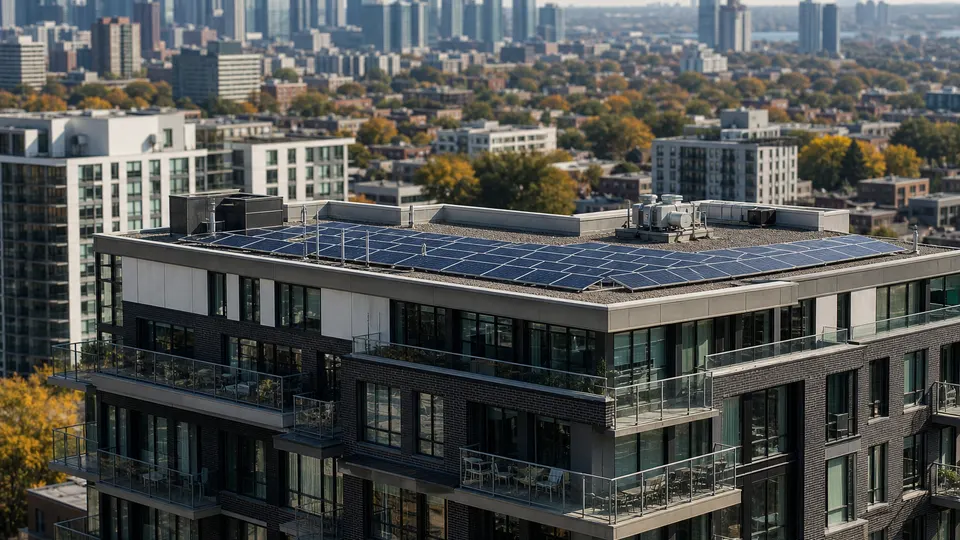
Urban Canadian solar growth hits a wall at the condominium door. Your unit may face south with excellent irradiance, but the roof is common property managed by a strata corporation. Approval paths differ from detached homes — and from American HOA fights often cited in online forums.
This guide clarifies who decides what in BC strata, Ontario condos, and Alberta multi-residential contexts, plus emerging bulk-building approaches.
Common property versus limited common property
Roofs, exterior walls, and facades are typically common property — owned collectively, maintained by strata or condo corporation. Limited common property (LCP) may assign specific roof sections to penthouse units. Your status determines whether you need:
- Simple owner request
- Three-quarter vote special resolution
- Full bylaws amendment
- Exclusive use agreement granting maintenance duty to one owner
Read your strata plan and bylaws before paying a solar deposit.
BC Strata Property Act considerations
BC has seen the most Canadian litigation and policy discussion on strata solar. Councils must not unreasonably withhold approval for alterations affecting only an owner's unit or designated LCP when engineering and insurance requirements are met — but "unreasonable" is adjudicated case by case. Document all council communications in writing.
Standard bylaws often require:
- Written alteration agreement
- Professional engineering for structural and wind load
- Insurance certificate naming strata as additional insured
- Maintenance covenant — owner pays removal cost on sale or leak trace-back
Ontario Condominium Act dynamics
Condo boards manage common elements under declaration and rules. Owner alterations to common elements need board consent per declaration — often a high bar. Toronto and Ottawa high-rises may prefer developer-led central solar on bulk meter over unit-by-unit rooftop patches that complicate membrane warranties.
New construction condos increasingly include solar in building design — retrofit remains harder on 1980s towers with aging membranes.
Alberta and Quebec multi-unit
Alberta condo law through Condominium Property Act parallels BC/Ontario themes — common property consent required. Quebec copropriété follows Civil Code rules on common vs private portions; French-language bylaws (déclaration de copropriété) govern. Montreal heritage copropriétés face additional aesthetic review.
Insurance and liability stacking
| Party | Typical insurance concern |
|---|---|
| Unit owner | Liability for install defect; rider for owned equipment |
| Strata corporation | Roof membrane warranty; fire spread; water ingress |
| Installer | Commercial liability; completed ops coverage |
Strata insurers sometimes surcharge or exclude owner-installed roof penetrations until engineering sign-off. Owner policies must list solar equipment value for replacement coverage.
Electrical allocation: one meter versus many
Unit-specific solar behind unit meter simplifies credits — rare on shared roofs. Building-level solar on common meter requires revenue or credit allocation formula among units — legal and billing complexity. BC Hydro and local LDCs differ on multi-unit net metering eligibility; verify before design.
Alternative: participation in community solar
Where rooftop approval fails, some provinces offer community solar or virtual net metering pilots — Alberta and Nova Scotia have seen programs. Ontario community solar remains limited for residential subscribers; check current registry rather than assuming availability.
Developer and council-led bulk solar
Progressive strata councils commission whole-roof arrays owned by corporation, distributing savings through reduced common fees or unit sub-metering. Single design avoids patchwork aesthetics and membrane disputes. Requires owner vote, financing plan, and professional property manager coordination.
Steps for unit owners seeking approval
- Obtain roof structural report from engineer familiar with strata process
- Prepare mock-up showing visibility from street — aesthetics matter to councils
- Draft maintenance and removal agreement indemnifying corporation
- Present at AGM with Q&A; bring installer for technical questions
- Allow six to eighteen months — rushed councils say no
When to walk away
- Roof scheduled for full membrane replacement within three years
- Bylaws explicitly ban roof penetrations without unanimous vote
- Insurance broker confirms no coverage available at reasonable cost
- Your section is overshadowed by mechanical penthouse bulkheads
Bottom line
Condo solar in Canada is a governance project before it is an electrical one. Success rates rise with engineering first, insurance packaged, and patience for strata politics. Detached-home installer sales scripts rarely transfer — seek firms with documented multi-unit references in your province.