
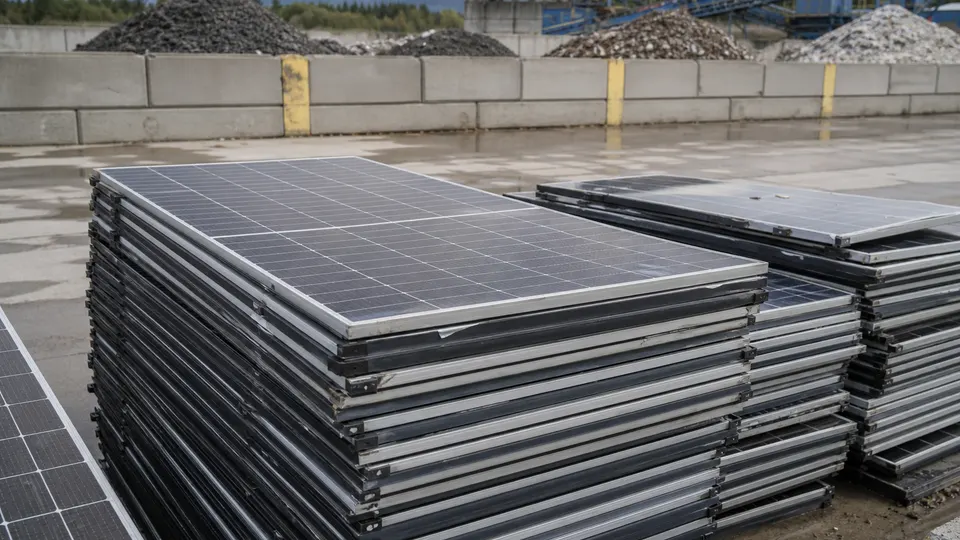
Solar panels contain glass, aluminum, copper, silicon, and small amounts of silver and other metals — valuable in aggregate, difficult to recover economically at small scale. Canada's first residential solar wave peaked around 2010–2015; mass decommissioning lies ahead. Understanding today's recycling pathways helps homeowners planning roof replacements, insurers after hail, and policymakers anticipating waste streams.
What is inside a typical crystalline module
By weight, modules are roughly seventy percent glass, fifteen percent aluminum frame, ten percent polymer backsheet and encapsulant, and five percent silicon cells and metals. Lead content in older solder may appear in pre-2015 modules — check manufacturer datasheets for RoHS compliance.
Current Canadian recycling capacity
Specialized recyclers operate in Ontario, Quebec, and BC — often processing commercial volumes and manufacturer take-back programs. Residential decommission batches of ten to forty modules may incur per-module fees because logistics dominate economics until volume scales.
- PV Cycle and manufacturer-led programs in some provinces
- E-waste processors accepting modules with advance arrangement
- Landfill bans absent in most provinces — landfill remains legal fallback, environmentally discouraged
Provincial extended producer responsibility trends
BC and other jurisdictions study EPR schemes for photovoltaic modules similar to electronics recycling fees. As of 2026, nationwide mandatory residential take-back is not uniform — homeowners should monitor provincial environment ministry updates. Quebec and Ontario environmental registries occasionally publish consultation papers on solar waste.
When panels leave the roof early
End-of-life is not only year twenty-five:
- Roof replacement: Remove and reinstall or replace aging modules
- Hail damage: Insurance totals array while cells still functional elsewhere
- Fire or arc fault: Partial array decommission
- Upgrade to higher efficiency: Financially rare for residential but occurs on commercial
Each scenario generates modules needing disposition before theoretical lifespan.
Reuse versus recycle
Secondary market exists for tested used panels — cottage off-grid, hobby projects, international export. Canadian Electrical Code and utility rules may restrict grid-tied install of used modules without engineering review. Reuse extends life; recycling recovers materials. Damaged glass modules should not be reused structurally.
Cost expectations for homeowners
| Disposition path | Typical cost (2026) |
|---|---|
| Landfill (where permitted) | $0–$50/module plus transport |
| Recycler processing fee | $15–$45/module |
| Installer haul-away in contract | Sometimes included in reroof quote |
| Donation to training program | Free; limited capacity |
Commercial fleets negotiate bulk rates — residential pays retail logistics.
Installer and manufacturer responsibilities
Some Canadian installers contractually haul away decommissioned modules when replacing with new arrays — ask before reroof projects. Manufacturers with offices in Canada may offer warranty-period recycling credits — rare but worth querying on premium brands.
Environmental comparison to avoided emissions
Lifecycle analyses show solar still net-positive on emissions despite imperfect recycling — energy payback in two to four years in Canadian climates. Recycling improvement reduces landfill glass and recovers aluminum; it does not negate solar's climate benefit narrative.
Planning for your future self
- Store module serial numbers and install date in home records
- Ask installer about reroof removal scope and recycling clause
- When replacing roof at year twenty, compare module replacement versus removal-only if production still acceptable
- Check insurer hail coverage for removal and disposal costs
Research and industry direction
Natural Resources Canada and academic labs pilot enhanced silicon recovery and silver extraction. Circular economy policy discussions include embedding recycling fees at import — not yet standard on residential invoices. Early adopters may pay disposal once; later cohorts may see EPR-funded free take-back.
Bottom line
Panel recycling in Canada is transitioning from niche to infrastructure. Today's homeowner should budget modest disposal fees on reroof day and favour installers who document recycling partners. The environmental case for solar does not require perfect recycling today — but responsible end-of-life planning closes the loop your neighbours will expect by 2035.