
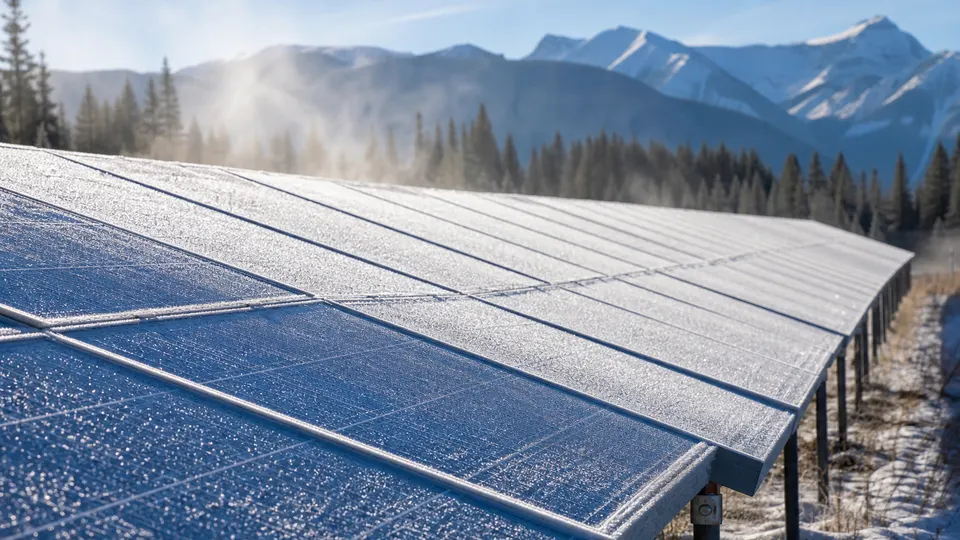
Ask a Saskatoon homeowner why solar feels counterintuitive in Canada and you will hear: "It is too cold here." The physics say the opposite — cold sunny weather is when crystalline silicon panels reach some of their highest instantaneous power output. The confusion comes from equating solar with summer heat. Panels are light engines; heat is mostly their enemy.
Understanding cold-weather performance helps you interpret winter monitoring dips, evaluate installer production models, and avoid blaming temperature for losses actually caused by snow cover or day length.
The temperature coefficient explained
Module datasheets rate power at 25 °C cell temperature under standard test conditions (1,000 W/m² irradiance). Real roofs exceed 25 °C cell temp on hot July afternoons — output drops roughly 0.3–0.4 percent per degree above 25 °C for modern monocrystalline panels.
Invert the season: at −10 °C ambient with good wind cooling, cell temperature may sit below 25 °C. The same panel briefly produces at or above its nameplate wattage during midday winter sun. Monitoring apps showing 105 percent of rated output in January are not broken.
Cold does not compensate for short days
Instantaneous efficiency gains do not overcome December's short photoperiod. A 7 kW system in Edmonton might produce 850 kWh in July but only 220 kWh in December regardless of temperature advantage. Annual energy planning must use monthly models, not peak watt snapshots.
Snow cover: the real winter enemy
Powder snow slides off tilted arrays above 30° on many roofs after chinook winds or mild thaws. Glazed ice crusts persist longer. Production loss from snow often exceeds loss from low temperature. Design responses:
- Steeper tilt where structurally allowed
- Microinverters or optimizers isolating shaded modules on partial snow cover
- Avoid manual scraping with metal tools — micro-cracks void warranties
Albedo boost from snow on the ground
Fresh snow reflects 70–90 percent of incident light. Panels on tilted mounts capture reflected light from the ground in addition to direct beam — a measurable winter gain once modules are clear but fields remain white. Studies in Alberta and Ontario note 2–8 percent annual yield uplift from albedo on fixed-tilt residential systems in snowy climates.
Wind cooling and mounting height
Roof-mounted arrays with airflow below modules stay cooler in summer and reach cold equilibrium faster in winter. Ballasted flat-roof systems on commercial buildings run hotter in summer — worse temperature coefficient penalty — but still benefit from cold winter days when exposed.
Comparing module types in cold climates
| Technology | Temperature coeff. (typical) | Cold-climate note |
|---|---|---|
| Monocrystalline PERC | −0.35 to −0.40 %/°C | Dominant residential choice; good cold performance |
| N-type TOPCon | −0.28 to −0.32 %/°C | Lower heat penalty; premium price |
| Thin-film (a-Si) | −0.20 %/°C approx. | Rare on rooftops; better shade tolerance |
Cold-climate buyers benefit from lower temperature coefficients but should not overpay solely for marginal winter gains — snow management and orientation dominate.
Inverter behaviour in freezing conditions
String inverters and microinverters operate across Canadian temperature ranges when installed to spec. Cold-start voltage from very cold modules can approach upper MPPT limits on cold bright mornings — reputable designs account for open-circuit voltage at record low temps. Installers must use NEC/CE Code temperature corrections for string sizing.
What monitoring should show in January
On clear days below −10 °C, expect sharp production spikes matching low cloud cover and clean modules. Multi-day flatlines indicate snow coverage. Compare against neighbours with similar azimuth on social media forums and you often find snow clearance differences, not equipment failure.
Installer modelling red flags
- Winter months modelled at zero production — outdated software
- Annual yield assuming no snow loss — optimistic for prairie roofs
- Using STC rating without temperature derate in summer peak estimates
Request PVWatts or PVSyst outputs with Canadian TMY weather files for your nearest city.
Takeaway for homeowners
Cold sunny weather is a feature, not a bug, for Canadian solar. Your panels are not lazy in winter because of temperature — they are starved for hours and occasionally blindfolded by snow. Clear modules on a crisp February noon can surprise you. Plan annual expectations around December day length and snow days, not thermometer readings.