
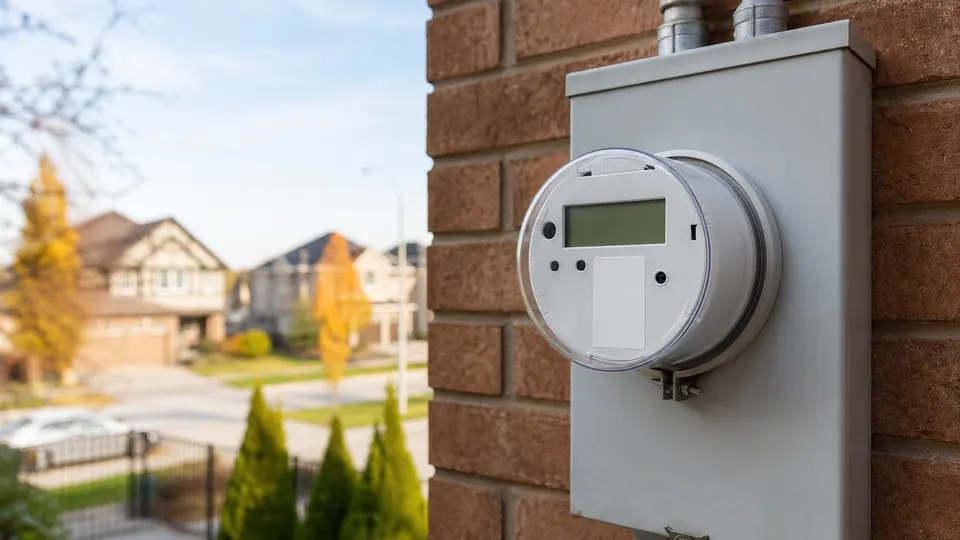
Ontario's net-metering framework allows residential and small commercial customers to generate electricity from renewable sources — primarily rooftop solar — and receive bill credits for surplus sent to the grid. It is not a cash payment program. Credits reduce what you owe on future bills within rules set by the Ontario Energy Board and administered by local distribution companies.
For homeowners from Windsor to Ottawa, understanding credits, caps, and billing cycles separates realistic payback from installer fantasy.
How net metering works on your bill
Your utility installs a bi-directional meter measuring electricity imported from the grid and exported from your solar array. Each billing period, exported kWh become credits applied against imported kWh charges, subject to your rate plan and utility tariff.
Net metering is a billing arrangement, not a separate income stream. You remain connected to the grid and pay fixed delivery charges, regulatory charges, and taxes that credits may not fully offset.
What credits cover — and what they do not
Credits typically apply to the energy (commodity) portion of your bill. Global adjustment, delivery, and other fixed fees often still appear monthly even when you export more energy than you import in a given period.
Homeowners on time-of-use (TOU) plans generate credits at the rate class associated with their net-metering agreement — historically aligned with time-of-use periods for many utilities, but implementation details vary by local distribution company (LDC).
Ultra-low overnight rate plans introduced in recent years changed the value proposition for solar: self-consuming during expensive peak periods matters more when off-peak import is cheap.
The 12-month true-up cycle
Ontario net metering generally operates on an annual reconciliation. Surplus credits accumulated during sunny months offset higher import months in winter. Credits that remain unused after the annual true-up may expire — they do not convert to cash.
Design system size to minimize chronic annual surplus. Oversizing strictly to "sell" power to the grid fails in Ontario because expired credits are lost value.
System size and eligibility caps
Net-metered generators must meet OEB rules and utility requirements. Key limits include:
- Generation capacity relative to your historical or expected load — utilities review that the system is sized for on-site consumption, not commercial export
- Maximum inverter and nameplate limits per connection point
- Single generator per account unless approved otherwise
Typical residential systems fall between 5 kW and 10 kW AC. Larger arrays on farm properties may qualify under different load demonstrations. Your LDC reviews an application with single-line diagrams and equipment specs before approving interconnection.
Application process through your LDC
- Submit net-metering application with system design and equipment certificates
- Receive conditional approval and connection agreement
- Install system; obtain Electrical Safety Authority inspection
- LDC installs bi-directional meter and assigns net-metering account status
- Begin generating; monitor first bills carefully for correct credit application
Timeline varies: Toronto Hydro, Hydro One, Alectra, and regional LDCs each have different queue lengths. Budget four to twelve weeks from install completion to full commissioning.
Time-of-use strategy with solar
Maximizing net-metering value on TOU means shifting load to solar production hours:
- Run dishwasher, laundry, and pool pumps mid-day when panels peak
- Pre-cool or pre-heat before on-peak windows using smart thermostats
- Schedule EV charging during midday solar surplus if not on dedicated overnight rates
Without load shifting, exported afternoon kWh may credit at a different effective value than the on-peak kWh you buy after sunset — depending on your utility's credit classification.
Net metering versus battery storage
Batteries store midday surplus for evening use instead of exporting at credit rates. Economics depend on:
- Differential between export credit value and peak import price
- Battery cost after any provincial incentives
- Backup power value during Ontario storm outages
In many GTA households, modest batteries improve self-consumption without changing net-metering registration. Islanding and backup require additional equipment and utility notification.
Urban versus rural LDC differences
Hydro One serving rural Ontario may have longer interconnection timelines and different line capacity constraints. Urban LDCs often have streamlined online portals. Farm properties must demonstrate load with metering history; cottage seasonal use complicates sizing approvals.
Comparison: net metering vs legacy microFIT
| Feature | Net metering (current) | microFIT (closed to new) |
|---|---|---|
| Compensation | Bill credits | Fixed contract price per kWh exported |
| New enrolment | Open | Closed |
| Primary benefit | Offset retail consumption | Export revenue (legacy contracts) |
| Sizing incentive | Match load | Was export-oriented within caps |
Buyers of homes with legacy microFIT contracts inherit contract terms — a different financial asset than standard net metering.
Bottom line for Ontario homeowners
Net metering makes solar a bill-management tool, not a business. Size for your load, shift consumption to sunny hours, and read your LDC connection agreement before you sign with an installer. Credits, caps, and rate-plan changes will evolve — but the fundamentals in Ontario reward self-consumption and punish chronic overproduction that expires at true-up.