
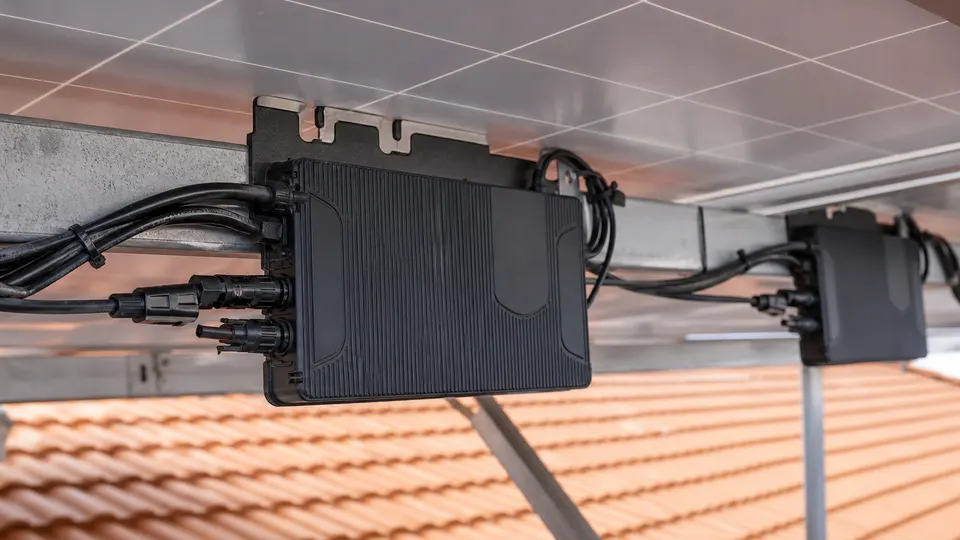
The inverter choice shapes how a Canadian rooftop handles imperfection. String inverters — one central unit converting DC from series-wired modules — dominate on open south-facing suburban roofs where shading is minimal. Microinverters and DC optimizers, collectively module-level power electronics or MLPE, attach per panel or per string to mitigate mismatch when chimneys, dormers, vent stacks or neighbouring maples cut across production zones. Snow cover that slides unevenly across a roof can mimic shading behaviour for weeks at a time in Winnipeg or Moncton.
This comparison focuses on real residential trade-offs: production under partial shade, hardware cost, warranty lifespans, winter service calls and monitoring — not abstract efficiency percentages from datasheets alone.
How string inverters work
Modules wire in series to reach voltage windows the inverter requires. Current through the string matches the weakest module — classic Christmas-light behaviour. One shaded or snow-covered panel can drag down an entire string until bypass diodes activate, wasting energy from unshaded modules on the same circuit.
String systems cost less per watt installed on simple roofs. One inverter on a garage wall simplifies maintenance access compared with twenty-plus roof-mounted devices. Canadian installers often specify string architecture for new subdivisions in Alberta and Ontario where roof planes are uniform and tree saplings have not matured yet.
How microinverters and optimizers work
Microinverters convert DC to AC at each module, parallel-combining on the roof. DC optimizers condition output from each module while a string inverter still handles conversion — a hybrid MLPE approach. Both architectures reduce mismatch losses when modules see different irradiance or temperature.
Brands commonly sold in Canada include Enphase microinverters, SolarEdge optimizers with central inverter, and APsystems multi-module micro units. Each ecosystem locks monitoring, warranty registration and replacement parts into vendor portals homeowners should preserve credentials for.
Shading scenarios where MLPE wins
- Chimney shading one corner of a main roof plane during morning or afternoon hours
- Dormer shadows crossing two modules on an otherwise clear string
- East-west split arrays with different production curves on the same electrical branch
- Partial snow retention after storms — common on shallow pitches in Quebec and the Maritimes
- Planned future tree growth along property lines in established neighbourhoods
Production modelling software like PVsyst or vendor tools quantify annual loss with and without MLPE. Ask installers for side-by-side estimates using the same shade objects — not generic national loss factors.
When string inverters remain sensible
Unshaded south roofs on detached homes with uniform pitch rarely justify MLPE premiums of fifteen to thirty percent on hardware. Large rural arrays on barns with clear horizon lines fit string economics. Cold-climate note: string inverters mounted indoors or on sheltered walls avoid roof-level exposure but concentrate failure risk — one fault stops the entire array until repaired.
Some string inverters now support dual MPPT inputs, allowing two orientations without full MLPE — useful for simple east-west splits with minimal obstruction between wings.
Snow and cold-climate behaviour
Canadian winters stress both architectures differently. Microinverters on roof surfaces experience full thermal cycling and must be rated for cold-start and moisture ingress. Enphase and competitors publish operating temperature ranges; verify units are listed for Canadian electrical certification. String inverters in heated garages start reliably but DC homerun wiring from roof to inverter must be sized for voltage rise and protected from rodent damage in rural installs.
Uneven snow shed creates string mismatch for weeks. MLPE isolates underperforming modules while neighbours produce — a meaningful winter advantage on shallow roofs in Ottawa and Halifax. Steep Calgary roofs may shed quickly enough that string systems catch up economically.
Cost and payback framing
On a typical 8 kW residential install in Ontario, MLPE hardware might add $1,500–$3,000 before incentives versus a mid-tier string inverter. Payback depends on shaded loss avoided. If shade analysis shows under three percent annual loss, string usually wins financially. If loss exceeds eight to ten percent, MLPE often repays within system life even after replacement reserves.
Include inverter replacement in lifetime cost models. String units may need swap at year twelve to eighteen; microinverter warranties sometimes reach twenty-five years on premium lines but confirm labour coverage.
Monitoring and troubleshooting
MLPE portals show per-module production — invaluable for spotting failing units, loose connectors or persistent snow cover. String systems display aggregate or string-level data; finding one weak module requires onsite testing. For DIY-minded owners in remote cottage country, granular monitoring reduces truck rolls.
Internet dependency matters: microinverter gateways need broadband or cellular for full features. Rural Saskatchewan installs should confirm cell coverage or plan for local-only commissioning tools.
Fire safety and rapid shutdown
Canadian Electrical Code evolution toward rapid shutdown on buildings influences MLPE adoption. Module-level shutdown can de-energize conductors on the roof during firefighter operations faster than some legacy string designs. Provincial adoption timing varies; qualified installers interpret current rules for your municipality during permit drawing.
Reliability and replacement logistics
Roof-mounted microinverter replacement requires a technician on ladders — sometimes in winter if a unit fails mid-season. String inverter swap happens at ground level but may leave the array offline entirely during repair. Stocking common SKUs matters: ask installers which replacement units they keep on vans in your province.
Expansion and battery coupling
Adding modules later is cleaner with some MLPE ecosystems that tolerate panel count changes without restringing voltage math. AC-coupled batteries like Tesla Powerwall or Canadian equivalents integrate with string or micro architectures differently — verify compatibility before assuming MLPE simplifies storage.
Decision matrix
- Choose string if shade loss under 3%, uniform south roof, budget-sensitive project, sheltered inverter location available.
- Choose MLPE if chimneys, trees or dormers shade multiple modules, east-west wings share a system, or monitoring granularity is worth premium.
- Re-evaluate ground mount if roof shade is severe — sometimes better solar access beats any inverter architecture on a bad roof.
Questions for your installer
- Show annual production with and without MLPE using site-specific shade objects.
- What is warranted labour for inverter replacement in year fifteen?
- Where does rapid shutdown equipment sit under current CE Code interpretation?
- How does snow retention on my pitch affect your string layout proposal?
- Who owns monitoring gateway credentials if your company closes?
Shaded Canadian roofs punish string systems for the same reason snow punishes uneven pitches — one weak module becomes everyone's problem until the sun returns.
Microinverters and string inverters are not moral choices — they are mismatch management strategies priced against your roof's actual imperfections. Run shade-aware production models, budget for mid-life hardware replacement, and match architecture to the way snow, trees and dormers interact with your modules through a full northern year.