
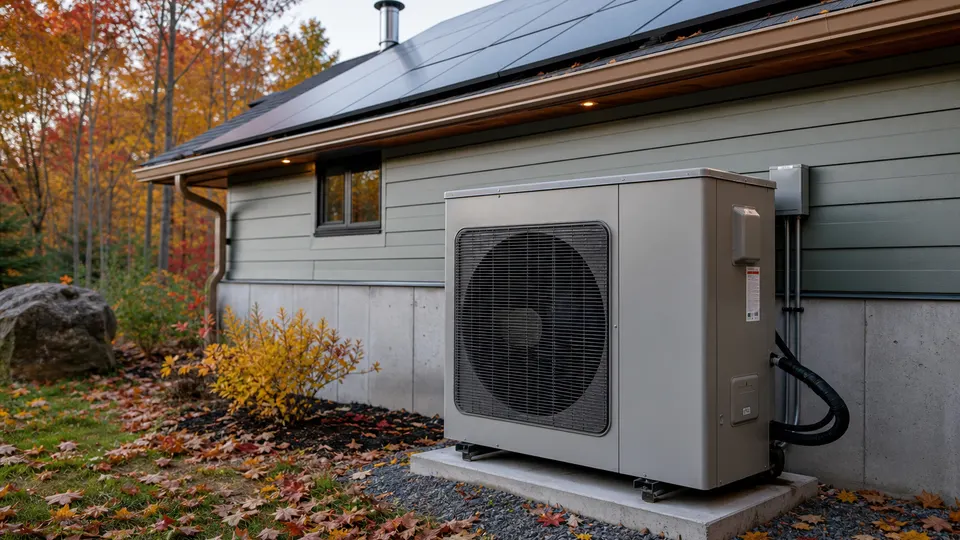
Most Canadian homes still burn fossil gas for heat. Electrifying with an air-source heat pump moves that load onto your electrical panel — often doubling annual kWh consumption. Rooftop solar, sized after the switch rather than before, converts sunshine into space heating dollars instead of merely offsetting lights and appliances.
Whole-home electrification is a sequencing problem: envelope, heat pump, panel, solar, and optional battery each change the next step. This guide walks through that order for climates from coastal BC to Montreal winters.
Why order matters: solar before heat pump often undersizes
Installers quoting solar on historic load data ignore future heat pump draw. A 6 kW array matching 8,000 kWh/year pre-electrification household leaves 4,000–8,000 kWh/year of new heating load on the grid — often during winter dark weeks when panels produce least.
Best practice: model post-electrification load, then size solar. Exceptions exist where federal or provincial rebate windows force timeline compression — document the upgrade path explicitly.
Cold-climate heat pump basics
Modern cold-climate air-source heat pumps maintain coefficient of performance (COP) above 2.0 down to −15 °C or lower on leading models. Below design temperature, backup resistance or hybrid gas may activate. Key specs for Canadian buyers:
- Heating capacity at −15 °C or −25 °C (not just rated at +8 °C)
- Sound ratings for urban lot lines
- Defrost cycle efficiency — excessive cycling wastes power in humid cold
- Integration with existing ductwork versus ductless heads
Load calculation example: Toronto detached
| Load category | Pre-electrification (kWh/yr) | Post heat pump (kWh/yr) |
|---|---|---|
| Baseload + appliances | 6,500 | 6,500 |
| Space heating (gas → electric) | 0 (gas) | 7,500–10,000 |
| Water heating | 2,500 (mixed) | 3,500–4,500 if heat pump water heater |
| EV (optional) | 0 | 3,000–4,500 |
| Total electrical | ~9,000 | ~20,000–25,000 |
Solar target might rise from 6 kW to 12–15 kW — subject to roof space, shading, and utility caps.
Envelope work first
Heat pumps reward tight, insulated shells. Programs through Natural Resources Canada and provincial efficiency offices still support audits and retrofits. Every dollar reducing heat loss shrinks required heat pump capacity and solar offset. Blower-door tests before and after envelope work quantify gains — useful for rebate documentation.
Panel and service upgrades
Heat pumps add 30–60 A of continuous load depending on backup configuration. Combined with solar backfeed and EV charging, 100 A services often require upgrade to 200 A before inspectors approve. Budget utility timeline alongside heat pump installation — cold weather install slots book early.
Solar offset strategy in winter-heavy load climates
You will not solar-cover January heat demand with July production without net metering annual true-up or battery storage. Canadian net metering in Ontario, BC, and Nova Scotia lets summer surplus credit winter imports. Size for annual net-zero electricity, not daily winter balance.
Load shifting helps: pre-heating thermal mass on sunny afternoons, smart thermostats coasting through evening peaks, and domestic hot water timers aligned with midday production.
Heat pump water heaters as solar sponges
Heat pump water heaters (HPWH) move 2–3 kW for hours — ideal programmable load during solar peaks. Some utilities offer demand-response credits. Pair HPWH with solar diverter switches or smart panel circuits routing excess to water heating before grid export.
Provincial incentive stacking (2026 snapshot)
Programs change frequently — verify eligibility before signing contracts. Typical layers:
- Canada Greener Homes loan and grant channels (check current federal status)
- Provincial heat pump rebates — BC, PEI, Nova Scotia historically active
- Utility-specific heat pump promotions
- Clean technology ITC for rental properties and corporations
Solar rebates may not stack with all heat pump grants on the same invoice — read fine print.
Battery: when it helps electrified homes
Batteries improve resilience during ice storms — increasingly relevant in Quebec and Ontario — and increase self-consumption of solar for evening heat pump run. Pure bill arbitrage remains weak where off-peak rates stay low. Size batteries for critical loads: heat pump fan, circulation pumps, fridge, communications — not whole-house resistance backup unless budget allows.
Case study: Halifax semi-detached
2024 envelope upgrade, 2025 cold-climate heat pump replacing oil furnace, 2026 11 kW solar. Annual electrical load rose from 11,000 to 19,000 kWh; solar produces ~13,500 kWh. Net metering true-up leaves roughly $600/year grid cost versus $2,800 oil before project. Simple payback on combined investment: roughly thirteen years including provincial rebates captured at time of install.
Mistakes to avoid
- Sizing heat pump on rule-of-thumb tonnage without Manual J or equivalent
- Installing solar on gas-heated load then complaining winter bills unchanged
- Ignoring defrost noise bylaws in dense neighbourhoods
- Skipping backup heat plan for −25 °C design days in northern climates
Integrated roadmap
- Energy audit and envelope improvements
- Electrical service assessment
- Heat pump and HPWH installation
- Twelve months utility bill baseline
- Solar design to new load profile
- EV and battery as later phases if panel allows
Heat pumps plus solar is the core of Canadian residential decarbonization. Treat them as one system — not two unrelated home upgrades.