
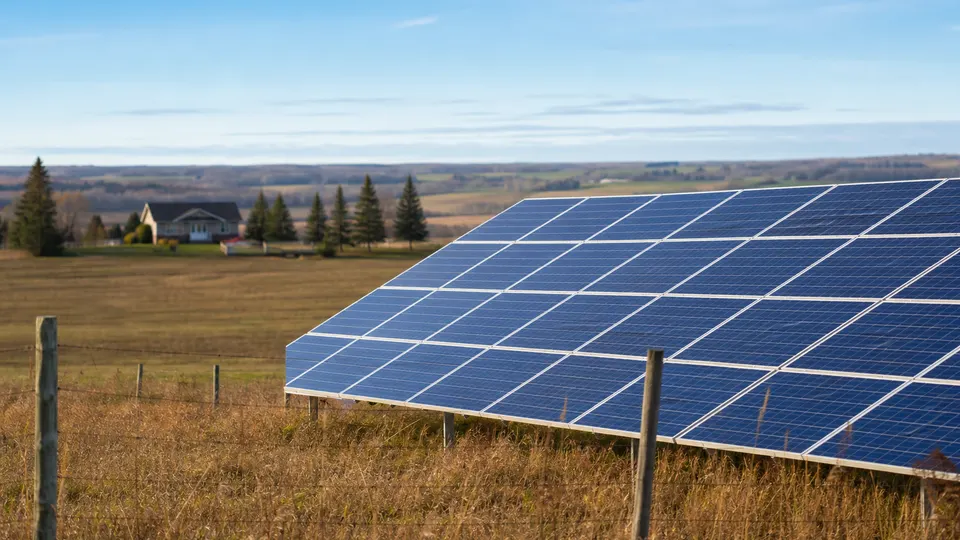
Farmhouse roofs in Alberta and Ontario may face east-west ridges, bear patchy shingles, or lack structure for racking. Open fields south of the barn often deliver unshaded solar access from 9 a.m. to 4 p.m. Ground-mounted arrays trade higher capital cost for optimal tilt, simpler cleaning, and deferred roof replacement — standard calculus on Canadian acreages.
This guide covers siting, foundations, utility runs, county bylaws, and livestock integration for rural ground-mount projects.
Ground mount versus rooftop on acreages
Advantages:
- Ideal south-facing tilt without roof geometry compromise
- No penetrations through aging roof membranes
- Access for maintenance without ladder or fall risk
- Future expansion rows easier to add
- Array size not limited by roof area — subject to utility caps
Disadvantages:
- Higher $/W for racking, foundations, trenching
- County setback and agricultural land use review
- Fencing and vegetation management ongoing
- Snow drift between rows in prairie winters
Foundation types for Canadian soils
Driven piles: Quick in firm soils; common on Prairies.
Concrete ballasted footings: Rocky Canadian Shield and permafrost-margin soils where driving fails.
Screw anchors: Removable preference on leased land or strict agricultural preservation zones.
Geotechnical review prevents frost heave misalignment — frost depth in northern Ontario and Manitoba exceeds 1.5 m; foundations must extend below.
Trenching and electrical run
Underground AC conduit from array to service entrance typically 30–150 metres on large lots. Costs include:
- Trenching through rock — explosive or specialized equipment premiums
- Crossing driveways — directional bore adds thousands
- Utility locate (Call Before You Dig / ClickBeforeYouDig) mandatory
- Separate DC trench rare — inverters often at array edge (string) or house (some designs)
Bury conduit below frost line per local code; sand bedding protects PVC in shifting clay.
County zoning and setbacks
| Requirement type | Typical rural range |
|---|---|
| Front yard setback | 15–30 m from road centreline |
| Side/rear property line | 3–7.5 m |
| Maximum height | 3–4 m to top of module |
| Agricultural zone review | Case-by-case in Ontario PDR zones |
Alberta county districts publish solar-specific bulletins — some classify ground mount as accessory structure, others as utility installation.
Wind and snow engineering
Open rural terrain exposure category increases wind load versus sheltered urban roofs. Engineers specify heavier racking and closer post spacing. Row spacing must allow snow shed without burying lower rows — especially on south-facing slopes in BC and Alberta foothills.
Livestock and vegetation
Sheep grazing under arrays controls weeds without heavy machinery near posts — growing practice in Ontario and Alberta agrivoltaics discussions. Cattle require taller mounts and robust fencing — cattle rub panels and bend frames. Horses similar. Keep inverter enclosures in locked steel boxes — curious animals and rodents both chew cables.
Micro-generation and export on farms
Farm electrical load often includes grain dryers, ventilation, and irrigation — high daytime draw aligns with solar production. Alberta micro-generation and Ontario net metering each size differently; oversizing for export alone rarely pays on residential-scale rules applied to farm accounts — verify account class with utility before design.
Cost comparison snapshot
Illustrative 10 kW project differences (2026 CAD, varied by region):
- Rooftop residential: $2.50–$3.20/W installed
- Ground mount same capacity: $2.90–$3.80/W installed
- Premium for long trench or rocky drill: +$3,000–$8,000 lump sum
Roof avoided replacement ($8,000–$15,000) offsets ground premium over twenty years on older farmhouses.
Security considerations
Remote arrays face wire theft and vandalism risk — motion lighting, locked combiner boxes, and insurance riders common. Some owners fence entire array perimeter; others rely on visibility from house yard.
Project sequence
- County planning pre-consultation
- Geotechnical and array layout with setbacks marked
- Utility interconnection pre-approval
- Foundations and racking before winter freeze (schedule critical)
- Electrical trench, conduit, inverter install
- ESA or provincial inspection and meter swap
Bottom line
Ground-mount solar fits rural Canada when roof is wrong but land is right. Budget trenching and county time alongside modules; integrate grazing or mowing plans from day one. The best acreage arrays look like farm infrastructure — because they are.