
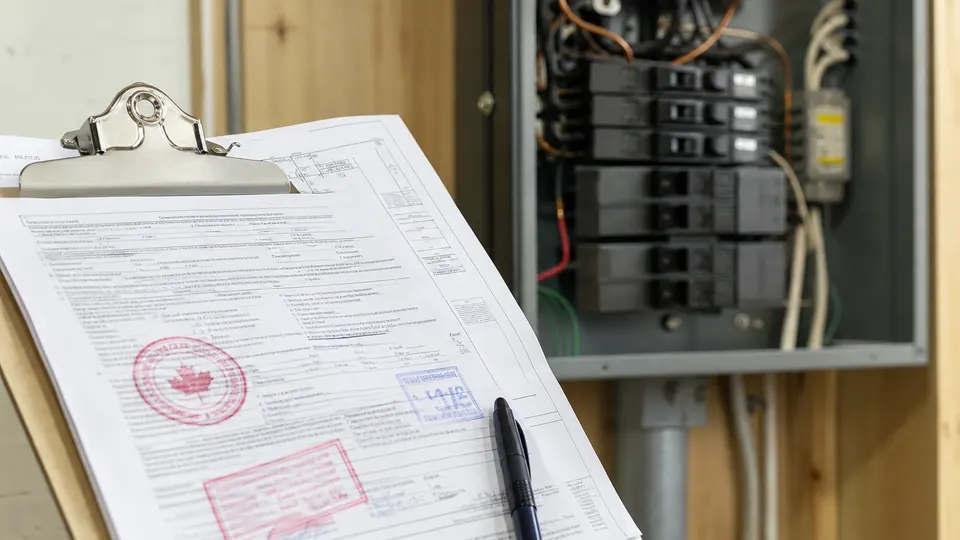
Connecting rooftop solar to the Canadian grid is not plug-and-play. Three separate gatekeepers — your municipality, your provincial safety authority, and your local distribution company — each issue approvals in sequence. Homeowners who treat permits as paperwork nuisance often discover they cannot legally energize their array, receive net-metering credits, or close out installer contracts.
This guide maps the standard path across provinces, with notes where Ontario, Alberta, BC, and Quebec diverge.
The three layers of approval
Building or development permit: Confirms zoning, setbacks, structural load, and sometimes heritage or HOA compliance.
Electrical permit and inspection: Provincial authority verifies CE Code compliance — wiring, grounding, rapid shutdown where required, labeling.
Utility interconnection: LDC or wire-owner approves inverter specs, metering, and connection agreement before export is allowed.
Installers usually file on your behalf, but the homeowner remains the account holder on utility agreements. Read what you sign.
Pre-application: what utilities require
Typical interconnection application package:
- Single-line electrical diagram
- Equipment spec sheets with CSA or UL listings accepted in Canada
- Inverter maximum output and proposed AC disconnect location
- Site plan showing array location and roof or ground dimensions
- Proof of property ownership or landlord consent
Many LDCs offer online portals — Toronto Hydro, BC Hydro, Enmax, and Hydro-Québec each use different forms. Conditional approval often precedes construction; final approval follows inspection.
Municipal permits by property type
Urban detached homes usually need a building permit for roof-mounted arrays. Content varies:
- Structural engineer letter for older roofs or ballasted flat-roof systems
- Heritage district review in cities like Montreal, Quebec City, Victoria
- Setback from ridges and fire pathways — National Building Code and local amendments
Rural agricultural properties may face county zoning for ground mounts. Indigenous reserve lands follow band council processes separate from municipal zoning.
Electrical inspection authorities
| Province/territory | Inspection body |
|---|---|
| Ontario | Electrical Safety Authority (ESA) |
| BC | Technical Safety BC |
| Alberta | Alberta Electrical Utility Safety Service (AEUSS) |
| Quebec | Corporation des maîtres électriciens du Québec (CMEQ) via licensed contractor |
| Manitoba | Manitoba Hydro inspection coordination |
Inspection occurs after rough-in and again at completion. Failed items must be corrected before utility meter swap.
Bi-directional meter installation
Your utility schedules meter replacement or reprogramming after passing electrical inspection. Timeline ranges from days to eight weeks depending on region and season. You may pay a connection fee — $500–$1,500 common in Ontario LDC territories.
Until the bi-directional meter is active, systems are often commissioned in limited export mode or left offline. Clarify in your installer contract who absorbs delay costs if utility queues slip.
Alberta competitive market specifics
Alberta micro-generators register with their wire-owner and retailer. The Alberta Utilities Commission framework sets size limits and billing rules; your retailer contract defines export credit terms. Permit path still runs through municipality plus AEUSS inspection, but billing setup requires retailer coordination separate from wire-owner meter work.
Quebec and Hydro-Québec
Hydro-Québec's self-generation program has distinct capacity tiers and application forms. French documentation is authoritative; English summaries exist but verify current tariff appendices. Rural Quebec long feed lines may trigger voltage study before approval.
Common delays and how to avoid them
- Wrong inverter on application: Submit exact model number; substitutions need amendment
- Panel full: Electrical load calculation should precede permit filing
- Roof work out of sequence: Some municipalities want structural approval before racking install
- Insurance gap: Notify insurer before energizing; some require proof of inspection
Post-commissioning checklist
- Receive connection agreement countersigned by utility
- Confirm first bill shows import/export separately
- Verify monitoring portal matches utility meter within five percent
- Store permit PDFs, inspection stickers photos, and warranty registrations
Who owns each failure point
Reputable installers contractually obligation permit filing and inspection scheduling. Homeowners still responsible for utility account accuracy, property access, and resolving HOA or heritage objections outside installer scope. If your installer disappears before inspection, another licensed contractor can close permits — but only with complete as-built documentation.
Bottom line
Permits are the skeleton of a legal grid-tied system. Budget six to sixteen weeks from contract signing to full export in most Canadian cities — longer in rural Hydro One territory. Sequence matters: utility conditional approval, build, electrical inspection, meter swap, monitoring verification. Skip none.