
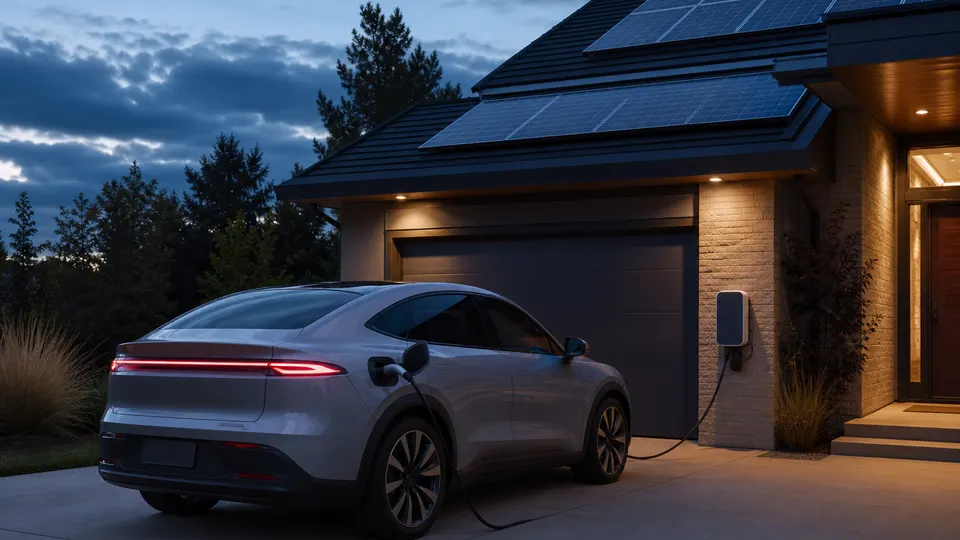
Adding an electric vehicle changes your home from a passive electricity consumer into a mobile load centre that arrives every evening needing 30 to 60 kWh per week. Rooftop solar produces most of its energy between 10 a.m. and 4 p.m. Aligning those two curves — generation on the roof and charging in the driveway — is one of the highest-value upgrades a Canadian household can make after going solar.
This guide covers charger selection, self-consumption strategy, and provincial billing realities for homeowners from Vancouver Island to Halifax who already have panels or are sizing a combined install.
Why EV load and solar production overlap matters
Without coordination, EV charging typically happens after work, during on-peak or mid-peak hours when panels produce nothing. You import expensive grid power to fill the battery in your car while midday surplus from your array exports at lower credit value — or disappears under net-metering true-up rules.
Shifting even half of weekly charging into solar hours can raise whole-system self-consumption from the low 40s to above 60 percent. That single behavioural and hardware shift often trims payback by two to four years in Ontario, Alberta, and BC markets where export credits undervalue retail import.
Level 1 versus Level 2 in a solar home
Level 1 charging from a standard 120 V outlet delivers roughly 1.4 kW — slow, but sometimes enough for commuters driving under 40 km daily. Level 2 at 240 V and 30–48 amps delivers 7 to 11 kW, filling a 60 kWh pack overnight or in a focused midday session.
For solar pairing, Level 2 with smart scheduling is usually worth the $800–$2,500 hardware cost plus installation. Midday bursts at 7 kW align with typical 5–10 kW residential arrays on clear days. Level 1 cannot absorb surplus fast enough during short winter sun windows.
Smart chargers and solar-aware modes
Many EV supply equipment (EVSE) brands sold in Canada offer:
- Scheduled charging: Set windows matching solar production hours
- Solar-only or excess-solar modes: Start charging only when export exceeds a threshold
- Load balancing: Reduce charge rate if the home approaches panel or service limits
- Utility rate integration: Pause during expensive TOU blocks if solar is insufficient
Verify that solar-aware features work with your inverter ecosystem — Enphase, SolarEdge, Fronius, and Tesla each expose production data differently. Some chargers need a CT clamp on the main service; others pull telemetry through Wi-Fi APIs.
Sizing solar for an EV
Rule of thumb: add 1 kW of DC capacity per 3,000 km of annual driving in southern Canada. A commuter driving 15,000 km/year might need 4–5 kW dedicated to transport — on top of baseline household load.
| Annual driving | Approx. kWh/year | Extra solar (kW DC, south-facing) |
|---|---|---|
| 10,000 km | 2,000–2,500 | 1.5–2.0 |
| 15,000 km | 3,000–3,750 | 2.5–3.5 |
| 20,000 km | 4,000–5,000 | 3.5–4.5 |
| 25,000 km | 5,000–6,250 | 4.5–5.5 |
Cold-weather range loss increases winter grid imports unless you oversize slightly or accept slower winter recovery.
Provincial billing: exports versus self-use
Ontario net metering: Credits expire at annual true-up. EV charging during solar hours directly avoids lost credit value.
BC Hydro net metering: Similar bill-credit logic; self-consumption during Step 2 rate tiers saves more than export credits in many regions.
Alberta micro-generation: Export value depends on retailer contract — midday self-use for EV charging often beats modest export rates.
Quebec: Low flat rates reduce solar arbitrage but EV charging still displaces grid energy; Hydro-Québec's rate structure favours shifting load rather than exporting.
Winter realities in Canada
December production in Toronto might be 250 kWh from a 7 kW system while an EV adds 350 kWh of need. Expect grid imports November through February regardless of pairing strategy. Summer surplus partially balances the year under net metering, but winter EV charging will pull from the grid unless you add battery storage.
Pre-conditioning the cabin while plugged in during morning solar ramp-up uses less pack energy before departure — a small but real winter efficiency gain.
Installation sequence that avoids rework
- Confirm electrical panel capacity for EV breaker plus solar backfeed
- Install solar and bi-directional meter first if timing allows
- Run EV circuit from panel to parking location with appropriate wire gauge
- Commission charger with CT clamps and test solar-only mode
- Document settings for future homeowners
Running conduit during a single roofing project saves drywall repair later.
Case study: suburban Ottawa duplex
6.4 kW rooftop, Hyundai Ioniq 5, Wallbox Pulsar Plus with solar surplus mode. Household shifted 58 percent of annual EV energy to self-consumed solar in year one — up from 41 percent with overnight dumb charging. Estimated annual savings versus overnight TOU import: $420 at 2026 rates. Combined solar-plus-EV simple payback improved from eleven years to roughly eight.
Common mistakes
- Installing charger without checking whether panel needs upgrade first
- Assuming every "smart" charger integrates with every inverter brand
- Oversizing solar for export rather than matching EV plus house load
- Ignoring second EV in household planning
Decision checklist
Proceed when your array or planned system exceeds 5 kW, you drive more than 12,000 km yearly, and your charger supports scheduled or solar-excess charging. Revisit panel capacity before adding a second EV — the next vehicle may not wait for a service upgrade.