
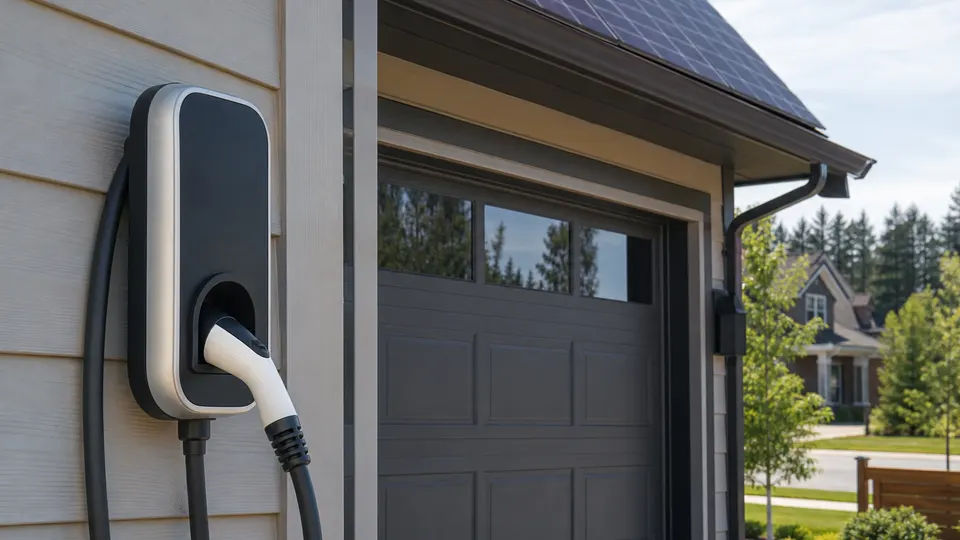
Rooftop solar and EV charging share one critical junction: your electrical panel. Solar backfeeds through a breaker; the EV charger pulls from the same bus. Canadian Electrical Code rules, utility interconnection limits, and dynamic load management together decide whether you need a $200 smart charger setting or a $4,000 panel and service upgrade. This article focuses on that electrical layer — not charger brands or driving habits.
Homeowners adding a Level 2 charger after solar — or planning both simultaneously — should treat the panel assessment as step one, not an afterthought buried in the installer quote.
How solar and EV loads interact at the panel
Grid-tied solar reduces net import during sunshine but does not reduce the maximum current your panel must safely carry in fault conditions. The utility cares about backfeed limits; your panel cares about total simultaneous load. An EV charging at 40 A plus a 50 A solar backfeed breaker, plus existing household circuits, can exceed bus ratings on older 100 A services common in pre-1990 Canadian housing stock.
Electricians apply the 120 percent rule (Rule 8-104 in the CE Code) for busbar calculations — solar and main breaker combinations have specific allowance patterns. Misapplication is a frequent cause of inspection failures.
When 100 A service is no longer enough
Many Canadian homes still operate on 100 A service. Typical upgrade triggers:
- 48 A EV circuit (60 A breaker) plus 7 kW solar backfeed on a full panel
- Heat pump addition planned within five years
- Finished basement suite with separate meter not yet installed
- Insurance or lender requiring 200 A for renovation permits
Utility service upgrades from 100 A to 200 A in Ontario often run $2,500–$5,500 including meter base work and LDC fees. Budget timeline: four to twelve weeks depending on utility queue.
Panel upgrade versus load management
Dynamic load management (DLM) devices monitor total service consumption and throttle EV charge rate when the home approaches capacity. Products from charge-point manufacturers and third-party vendors can keep a 100 A service viable longer.
| Approach | Typical cost | Best for |
|---|---|---|
| DLM with CT on main | $300–$800 plus install | Single EV, moderate solar, tight but compliant panel |
| Panel swap (same amperage) | $1,500–$3,000 | Full bus, adequate service, unsafe or obsolete panel |
| Service upgrade to 200 A | $2,500–$5,500 | Second EV, heat pump, large solar planned |
| Solar-ready panel at upgrade | Included in above | New installs avoiding future rework |
DLM is not a workaround for genuinely undersized service conductors from the street. It manages simultaneous peak, not total growth in household electrification.
Utility interconnection limits
Local distribution companies cap inverter output relative to service size. Common patterns:
- Maximum inverter nameplate often limited to service rating (e.g., 10 kW AC on 100 A service in some LDC territories)
- Line-side tap connections bypass panel bus limits but require utility approval and specialized installation
- Supply-side connections more common on commercial; residential line-side taps remain rare and utility-specific
If your solar installer sized to the old panel limit, adding EV load does not change the inverter cap — but it changes your internal load profile and may trigger a service upgrade request when you apply for charger permits.
Permitting and inspection sequence
Electrical Safety Authority (Ontario), Technical Safety BC, and provincial equivalents inspect both solar and EV circuits. Typical failure points:
- Missing equipment grounding conductor on EV circuit
- Breaker space filled without proper slot hardware
- Solar backfeed breaker not at opposite end of bus from main
- Load calculation paperwork omitting EV continuous load factor
Pull permits for EV and solar together when possible. Inspectors reviewing a panel once apply consistent interpretation; piecemeal permits risk conflicting corrections.
Load management integration with solar inverters
Advanced setups coordinate DLM with solar production telemetry:
- Throttle EV only when net import exceeds threshold, not when solar is covering house load
- Prioritize self-consumption before throttling — charging slows only when grid import plus EV would exceed service limit
- Some inverter APIs expose "available export" data usable by compatible EVSE
Integration depth varies. Ask your electrician for a written single-line diagram showing CT placement, DLM logic, and solar backfeed breaker location before work begins.
Planning for the second EV
Dual-EV households on 200 A service still hit limits when both chargers run at full rate during cloudy evenings. Options include:
- Shared circuit with power sharing between two EVSE units
- Lower default amperage per charger with manual override
- Scheduled charging windows staggered by vehicle
Installing oversized conduit and a subpanel near the garage during the first project costs little compared to trenching twice.
Rural and cottage considerations
Hydro One and regional utilities serving acreages may have long service upgrade lead times. Off-grid cottages adding EV charging face inverter and generator sizing entirely separate from suburban panel math — but seasonal Canadian cottagers increasingly want Level 2 at the lake. Undersized transformers on long rural feeds can cause voltage drop when EV chargers start — voltage rise issues appear with solar export on the same long line. Utility engineering review may be mandatory.
Questions for your electrician before signing
- What is the calculated load under CE Code Rule 8-200 or 8-202 for my dwelling?
- Does my panel support 120 percent backfeed with proposed solar breaker size?
- Will DLM keep me compliant without service upgrade, and under what assumptions?
- Who pulls permits — solar installer, EV installer, or general electrician?
- Is a line-side tap available from my LDC if panel space is exhausted?
Bottom line
EV plus solar is electrically straightforward on a modern 200 A panel with room to grow. On legacy 100 A services, load management buys time but does not replace honest capacity planning for heat pumps and second vehicles. Get the panel calculation in writing before you buy the charger — the cheapest EVSE deal means nothing if the inspection fails or the utility rejects your interconnection amendment.