
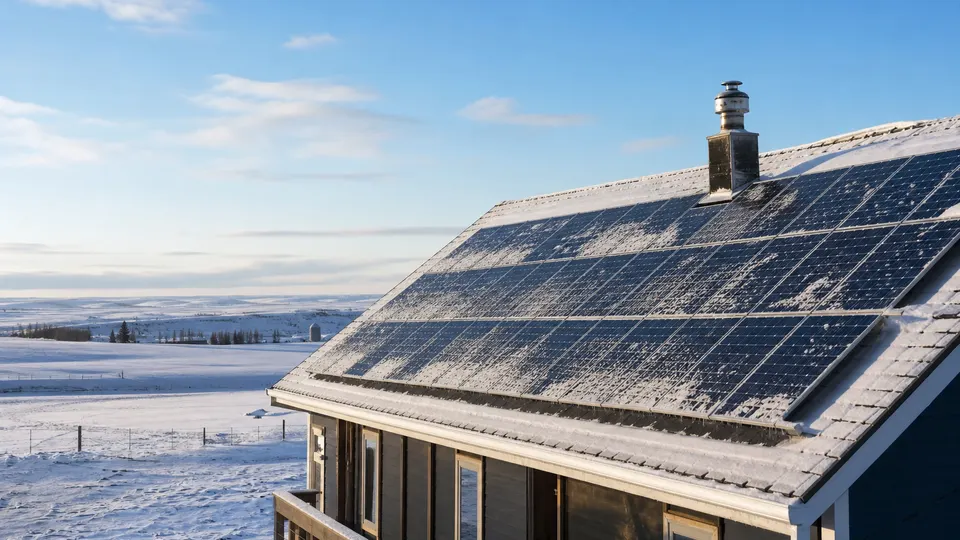
On a −18 °C January morning in Red Deer, the photovoltaic modules on a family farmhouse were producing 4.2 kW — nearly their summer noon plateau minus angle-of-incidence losses. Counter-intuitive? Only if you assume solar is a desert technology. Photovoltaic cells convert light, not heat, and cold dense air improves conductivity. Alberta's solar story is not about insufficient sun; it is about engineering for snow, hail, and export contracts.
This technical guide targets Alberta homeowners evaluating rooftop or ground-mount solar in 2026 — especially those comparing installer production models against real cold-climate data. When you finish the sections below, a short roof-readiness quiz helps you organize the questions worth asking before you request quotes.
Why Alberta is a high-resource jurisdiction
Natural Resources Canada solar maps place much of southern Alberta in the 1,200–1,400 kWh per kW installed range annually — competitive with Ontario and superior to coastal BC despite BC's milder winters. Calgary averages more than 2,300 sunshine hours per year; Edmonton exceeds 2,200. The province's micro-generation regulation allows small producers to export surplus generation and receive credits through their retailer contract, subject to size limits and billing rules administered under the Alberta Utilities Commission framework.
Economics improved as module prices fell and local installer experience matured. Economics also became more volatile as provincial rebate programs opened and closed with political cycles. Plan projects on current retailer export rates and hardware costs, not nostalgia for past grants.
Cold weather performance: the physics homeowners miss
Module efficiency ratings — typically measured at 25 °C — mislead lay readers. Real output depends on:
- Irradiance: Clear winter days deliver strong production when panels are not snow-covered.
- Temperature coefficient: Modern monocrystalline panels lose less output per degree above 25 °C; below 25 °C they often outperform rated specs briefly.
- Albedo effect: Snow on the ground can reflect additional light onto tilted arrays, boosting winter yield after storms.
- Day length: Short December days cap total energy regardless of efficiency — December kWh will always trail July.
Installers should provide monthly production estimates, not only annual totals. If their model flat-lines winter months at zero, ask which software they use and whether it incorporates Alberta TMY weather files.
"Our monitoring portal showed February outperforming the installer's pessimistic spreadsheet by nineteen percent. The cold wasn't the enemy — March slush events were." — Agricultural property owner, Lethbridge County, 2025
Snow load, shedding, and roof safety
Snow management separates prairie installations from Vancouver Island ones. Key design variables:
| Factor | Recommendation | Rationale |
|---|---|---|
| Module tilt | 30°–45° typical for shedding | Shallow tilts retain snow longer |
| Row spacing (ground mount) | Avoid inter-row shading from snow piles | Especially on south-facing slopes |
| Roof load rating | Structural review for older farm buildings | Panels add dead load; snow may linger before shed |
| Manual clearing | Avoid metal tools on glass | Micro-fractures void warranties |
| Microinverters vs string | Shade/snow on one module affects string systems more | MLPE can isolate underperforming sections |
Chinook winds in Calgary and southern Alberta can strip roofs quickly — sometimes violently. Ensure racking engineering meets local wind load codes. In Edmonton and northern Alberta, persistent snow cover may last longer; production dips until melt exposes glass.
Hail risk in the hail alley
Calgary is among Canada's most hail-active metros. Comprehensive insurance and module impact ratings matter. After major hail events, fleets of roofers appear — solar owners must document module damage separately from shingles. Questions for your insurer before install:
- Are panels covered under the homeowner policy or a rider?
- Is actual cash value applied to aged modules?
- Does the deductible differ for named storm events?
- Must repairs use specific vendors for warranty continuity?
Some manufacturers certify hail resistance to IEC standards; ask for datasheet proof, not brochure icons.
Micro-generation and retailer contracts
Alberta's competitive electricity market means your solar export value depends on your retailer contract, not a single provincial feed-in tariff. Micro-generators up to the regulated size threshold export surplus and receive credits on their bill per AUC rules. Retailers offer varying terms for export rates and rollover of credits — read the fine print.
- System size cap: Residential systems must respect micro-generation limits; oversizing without approval creates billing problems.
- Bi-directional metering: Your retailer arranges meter swap timelines — budget delays into the construction schedule.
- Switching retailers: Export terms may change when you switch; compare solar-friendly contracts annually.
- Grid carbon intensity: Alberta's grid is decarbonizing; solar displacement economics shift as grid intensity falls — still valuable for bill stability.
Ground mount versus rooftop in rural Alberta
Acreage owners often prefer ground mounts for orientation control and roof longevity. Trade-offs include fencing and weed management around arrays, longer trenching runs to the service entrance, municipal setback rules in county districts, and niche agrivoltaics experiments that remain uncommon in 2026.
Urban Calgary and Edmonton infill lots usually lack space; rooftops dominate. Heritage districts and restrictive covenants in master-planned communities may limit visible panels — check land-use bylaws early.
Pairing solar with Alberta's heating reality
Most Alberta homes burn natural gas for space heat. Solar does not directly displace gas unless you electrify — heat pumps, electric boilers, or significant resistance backup. A practical sequence:
- Reduce load with insulation and air sealing.
- Convert space and water heating where heat pumps make economic sense.
- Size solar to the new electrical baseline including EV charging.
- Consider battery storage only after load and export rules are optimized — batteries remain costly for pure bill arbitrage in Alberta.
"We stopped selling solar as a standalone widget. The homes that win financially electrify first, then right-size the array. Cold climate rewards integrated design." — Energy auditor, Edmonton, 2025
Production modelling: Calgary versus Edmonton
Illustrative annual production for a 7 kW south-facing tilted system, no major shading, using typical Alberta modelling assumptions:
| Month | Calgary (kWh approx.) | Edmonton (kWh approx.) |
|---|---|---|
| January | 280 | 250 |
| February | 350 | 310 |
| March | 520 | 480 |
| April | 680 | 640 |
| May | 780 | 740 |
| June | 820 | 790 |
| July | 850 | 820 |
| August | 780 | 750 |
| September | 620 | 590 |
| October | 480 | 440 |
| November | 320 | 280 |
| December | 250 | 220 |
| Annual total | ~7,730 | ~7,310 |
At $0.15/kWh blended retail value, that is roughly $1,100–$1,160/year offset before export nuances. Payback stretches or compresses with install price, rebates, and self-consumption share.
Case study: Calgary infill with EV
A 2022-built duplex with a 5.6 kW rooftop and microinverters cost about $18,500 net of a provincial rebate available at the time. The household added 12,000 km/year of home EV charging. Self-consumption rose from 42% to 61% after the vehicle arrived because charging aligned with sunny afternoons. Simple payback improved from fourteen years to roughly ten despite losing some export credits. Snow losses averaged eleven production-days equivalent per winter — acceptable to owners who valued predictable transport energy costs.
Wildfire smoke and air quality events
Alberta summers increasingly include wildfire smoke weeks. Particulates reduce irradiance; production can drop 20–40% on heavy smoke days without damaging hardware. Monitoring data from 2023–2025 fire seasons is now included in serious installer proposals — ask for sensitivity analysis if you are risk-averse.
Permitting, inspection, and interconnection sequence
Never pay final balance before the municipal electrical permit is closed, the provincial electrical inspection has passed, the bi-directional meter is installed and commissioned, and monitoring is verified against the installer's guarantee baseline. Rural counties may have longer inspection windows — sequence matters for winter construction cutoffs.
Maintenance in cold climates
Solar is low maintenance, not zero maintenance. Schedule an annual visual inspection for wire chew from rodents — common on acreages — loose clamps after thermal cycling, and inverter error logs. After hail, drone or ground photos document claims. Avoid pressure washing modules in freezing conditions.
Decision framework for 2026
Proceed with detailed quotes if your roof or ground site has unshaded solar access, your electrical panel accepts interconnection, you plan to stay in the home long enough to capture 8+ years of production, and you understand export credit terms. Pause if the roof needs replacement within five years, covenants prohibit arrays, your retailer contract penalizes export, or insulation and air sealing are untreated in a high gas-heat home.
Cold-climate solar in Alberta is neither experimental nor automatic. Treat it as a small power plant on your property — engineered for snow, insured for hail, and sized for how you actually use electricity after the next chinook melts the drifts off your roof.
Use the short quiz below to check whether your climate, roof, and goals line up with a cold-climate install — then decide whether a deeper site assessment is worth your time.
Does your roof qualify?
Sponsored article with partner links. Prices and terms may vary. This content is not professional advice.