
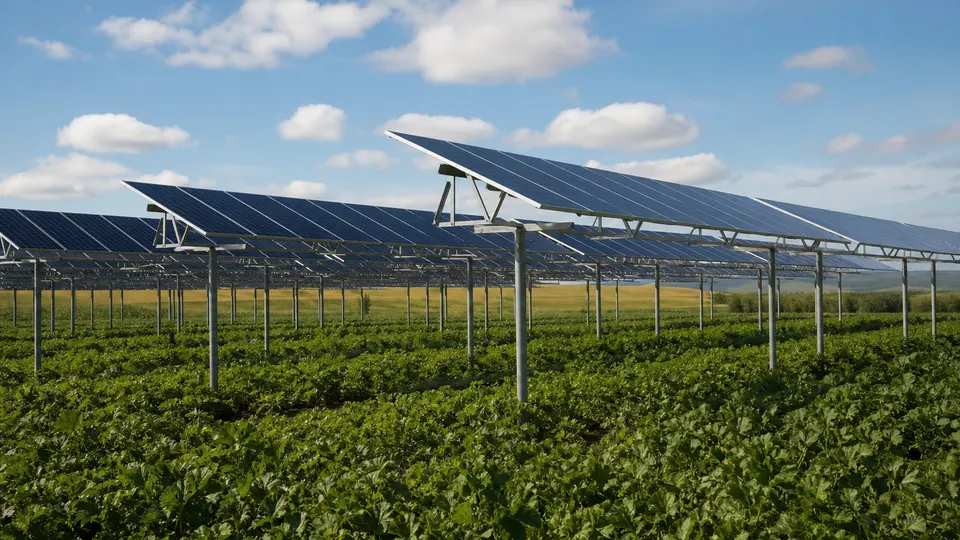
Canadian farmland faces competing pressures: rising input costs, climate volatility, and energy bills for irrigation and cold storage. Agrivoltaics — mounting solar panels high enough above crops or pasture to allow continued farming — promises two revenue streams from the same hectare. Early pilots across Canada suggest the concept works in specific contexts, but it is not a default upgrade for every farm.
This article surveys 2024–2026 Canadian agrivoltaics trials, regulatory framing, and practical questions for producers considering elevated arrays.
What agrivoltaics means on prairie versus orchard land
Design varies by crop and livestock:
- Field crops (soy, wheat): Higher panel rows (5–6 m) with wide spacing for machinery passage
- Berries and vegetables: Semi-transparent modules or spaced arrays reducing heat stress
- Sheep grazing: Panels provide shade; sheep control vegetation under arrays
- Cattle: Requires robust fencing and height — cattle rub and damage lower mounts
Southern Ontario berry growers report reduced irrigation demand under partial shade during July heat domes. Alberta sheep graziers use flocks as low-cost vegetation management under standard ground-mount rows.
Canadian pilot projects and research nodes
Universities and federal labs track agrivoltaics through Natural Resources Canada and Agriculture and Agri-Food Canada channels. Notable directions:
- Ontario tender-fruit and ginseng operations testing shade-percentage economics
- Quebec dairy farms evaluating barn-roof plus field-mount combinations
- BC Fraser Valley high-value crop trials with elevated tracking arrays
- Saskatchewan and Alberta dryland plots measuring soil moisture retention under panels
Most pilots remain sub-megawatt — research scale, not yet utility-scale dual-use standardization.
Revenue stacking: electricity plus yield effects
Farm economics must account for:
- Electricity offset for irrigation pumps, grain dryers, and barn ventilation
- Net metering or micro-generation export credits
- Crop yield changes — positive for shade-tolerant crops, negative if spacing blocks equipment
- Carbon and sustainability premiums from buyers — emerging, not guaranteed
| Revenue stream | Typical scale (2026) | Notes |
|---|---|---|
| On-farm use offset | $15,000–$80,000/year | Depends on array size and load |
| Export credits | Varies by province/retailer | Often lower value than self-use |
| Yield change | −10% to +15% | Crop and design dependent |
| Grazing fee savings | $500–$2,000/year | Sheep under arrays |
Regulatory and zoning considerations
Agricultural land use policies differ by province. Ontario's Provincial Policy Statement and local official plans may classify ground-mount solar on prime agricultural land differently from rooftop barn systems. Alberta counties set setback rules for structures in agricultural districts. Quebec's Commission de protection du territoire agricole du Québec (CPTAQ) reviews non-agricultural uses on agricultural zoned land — agrivoltaics may require exemption demonstrating continued production.
Start with municipal planning and provincial agriculture ministry guidance before capital commitment.
Structural and wind load engineering
Elevated arrays cost more per watt than standard ground mounts. Taller columns, deeper foundations, and wider footings resist prairie wind and ice loading. Engineers must account for:
- ASCE 7 or NBC wind loads for open terrain exposure
- Snow drift between rows affecting access roads
- Equipment turning radii for modern combines
Insurance under farm policies may require third-party engineering sign-off beyond installer standard packages.
Microclimates under panels
Partial shade reduces evapotranspiration — valuable during drought years on the Prairies. Conversely, prolonged humidity under dense arrays can increase fungal pressure on certain crops. Research at Ontario agricultural stations tracks humidity, pollinator activity, and soil temperature gradients. Pollinator-friendly seed mixes under arrays appear in some BC and Ontario designs for ecosystem service narratives.
Financing and grants
Federal clean technology investment tax credits and accelerated capital cost allowance may apply to farm corporations. Residential-style rebates rarely fit commercial farm entities — consult accountants on ITC stacking with provincial programs. Agricultural lenders increasingly familiar with solar collateral but may require production guarantees and O&M reserves.
When agrivoltaics beats separate land uses
Favourable conditions:
- High-value crops benefiting from heat stress reduction
- Significant on-farm electrical load (dairy, cold storage, irrigation)
- Sheep integration already part of operation
- Land not suitable for highest-yield row crops but adequate for grazing
Poor fit:
- Large-scale grain operations needing unimpeded field geometry
- Short lease land without long-term tenure security
- Areas with restrictive agricultural preservation bylaws banning structures
Practical first steps for producers
- Map annual kWh use and peak demand for farm operations
- Consult county planner on agrivoltaics precedents
- Request shade study from installer with crop consultant input
- Compare standard ground-mount solar on marginal land versus elevated dual-use design
- Negotiate O&M access routes that preserve planting schedules
Looking ahead
Agrivoltaics in Canada remains experimental at commercial scale but accelerating where energy costs and climate stress intersect. Farms that treat panels as farm infrastructure — not a side hustle — integrate grazing, irrigation timing, and equipment logistics from day one. Wait for copy-paste templates at your peril; site-specific design is the norm through 2026.